kiruthika
Introduction
Satellite internet used to mean one thing: slow speeds, high prices, and long waits for data to travel to space and back. That’s changed fast.
This satellite internet comparison 2026 breaks down Starlink, Amazon Leo, Viasat, HughesNet, and other low earth orbit internet providers using their actual current pricing, speeds, and 2026 news. One legacy provider just filed for bankruptcy. A new giant is about to enter the market. Here’s where things actually stand.
Key Highlights (Quick Facts)
- Starlink raised its US residential prices in June 2026, with current plans running $55, $80, and $130 per month, plus a $349 dish or $10/month rental.
- Starlink had passed 10 million subscribers by February 2026 and operates a constellation of more than 10,000 satellites.
- Independent Ookla testing put Starlink’s US median download speed at roughly 130 Mbps in late 2025, with real-world household results typically landing between 50–220 Mbps.
- Amazon Leo (formerly Project Kuiper, renamed in November 2025) is targeting a mid-2026 consumer launch in the US, Canada, UK, France, and Germany, with terminals promising up to 1 Gbps (Leo Ultra).
- Hughes Network Systems, the company behind HughesNet, filed for Chapter 11 bankruptcy on August 2, 2026, citing sustained subscriber losses to Starlink and other low earth orbit competitors.
- HughesNet’s subscriber base fell to roughly 622,000–681,000 in 2026, down from about 1.4 million in 2022.
- Viasat and HughesNet are both traditional geostationary (GEO) satellite providers, meaning higher latency (around 600ms) compared to LEO providers like Starlink.
- Eutelsat OneWeb and Telesat Lightspeed are active in the LEO race but remain mostly focused on enterprise, government, and aviation customers rather than home internet.
What “Satellite Internet” Actually Means in 2026
Not all satellite internet works the same way, and that difference explains most of the price and speed gaps you’ll see below.
Geostationary (GEO) satellites, used by Viasat and HughesNet, sit about 22,236 miles above Earth. That huge distance is why their connections have noticeably higher latency, often around 600 milliseconds.
Low Earth Orbit (LEO) satellites, used by Starlink, Amazon Leo, and OneWeb, orbit just a few hundred miles up. That’s why they deliver much lower latency and faster real-world speeds.
Why This Matters for Everyday Use
Latency is the delay before your data starts moving, not just how fast it moves once it does. High latency on GEO satellite plans makes video calls choppy and online gaming nearly unplayable, even if the download speed number looks decent on paper.
LEO providers close that gap. That’s the main reason Starlink has been steadily pulling subscribers away from older satellite providers.
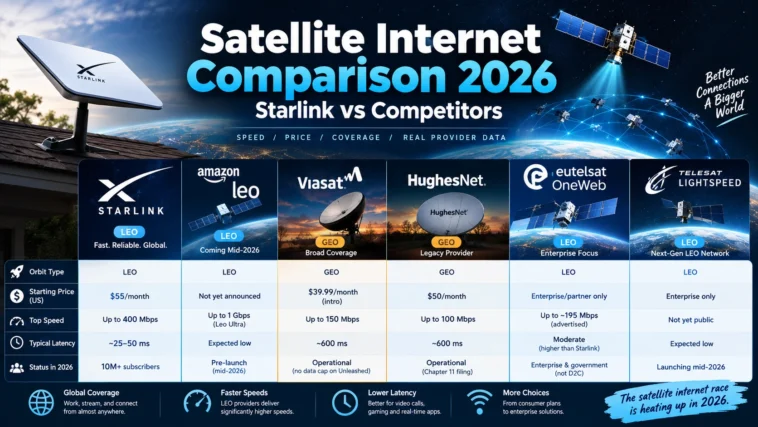
Starlink vs Competitors 2026: Full Comparison Table
| Provider | Orbit Type | Starting Price (US) | Top Speed | Typical Latency | Status in 2026 |
| Starlink | LEO | $55/month | Up to 400 Mbps (Max plan) | ~25–50 ms | Fully operational, 10M+ subscribers |
| Amazon Leo | LEO | Not yet announced | Up to 1 Gbps (Leo Ultra) | Expected low, similar to Starlink | Pre-launch, targeting mid-2026 |
| Viasat | GEO | $39.99/month (intro) | Up to 150 Mbps | ~600 ms | Operational, no data cap on Unleashed plans |
| HughesNet | GEO | $50/month | Up to 100 Mbps | ~600 ms | Operational, parent company in Chapter 11 |
| Eutelsat OneWeb | LEO | Enterprise/partner only | Up to ~195 Mbps advertised | Moderate (higher altitude than Starlink) | Operational for enterprise, not direct-to-consumer |
| Telesat Lightspeed | LEO | Enterprise only | Not yet public | Expected low | Satellite launches beginning mid-2026 |
Provider-by-Provider Breakdown
Starlink: The Current Market Leader
Starlink dominates the LEO satellite internet market by a wide margin. As of August 2026, its US residential lineup includes three tiers: Residential 100 ($55/month), Residential 200 ($80/month), and Residential Max ($130/month), following a price increase that took effect with June 2026 billing.
The Standard dish costs $349 to buy outright, or $10/month to rent in eligible areas. Roam plans, built for RVs, boats, and travelers, start at $55/month for 100GB of priority data.
Real-world performance has become genuinely competitive. Ookla data put Starlink’s US median download speed at about 130 Mbps in late 2025, with household experiences typically ranging from 50 to 220 Mbps depending on location and network congestion.
Amazon Leo: The Challenger Still Getting Off the Ground
Amazon rebranded Project Kuiper to Amazon Leo on November 13, 2025. The name is a nod to the low Earth orbit technology behind it.
Amazon has three terminal tiers planned: Leo Nano (up to 100 Mbps), Leo Pro (up to 400 Mbps), and the enterprise-focused Leo Ultra (up to 1 Gbps download, 400 Mbps upload). In January 2026, the FCC approved Amazon’s request to launch 4,500 additional satellites, bringing its total planned constellation to 7,727 satellites, with more than 200 already in orbit by early 2026.
Consumer pricing has not been officially announced. Amazon needs at least 578 operational satellites for initial coverage, and CEO Andy Jassy has pointed to a mid-2026 consumer launch target, with broader rollout expected into 2027.
Viasat: Best for No Data Cap, No Contract Flexibility
Viasat’s Essentials plan starts around $39.99/month for the first three months (150GB, up to 150 Mbps), but requires a 12-month contract. Its Unleashed plans start at $69.99/month and go up to roughly $129.99/month, with no hard data cap, though a 12-month contract still applies to some tiers.
Viasat remains a GEO satellite service, so while its top speeds beat HughesNet, its latency stays in the same high range typical of geostationary satellites.
HughesNet: Budget Option Now in Financial Trouble
HughesNet plans run from about $50 to $170/month, with download speeds between 25 and 100 Mbps depending on the plan. Its top-tier Fusion plan blends satellite with fixed wireless to cut down on latency.
The bigger story here is corporate, not technical. On August 2, 2026, Hughes Satellite Systems Corporation and several US subsidiaries, including Hughes Network Systems, filed for Chapter 11 bankruptcy. The filing followed a $1.5 billion debt maturity the company couldn’t cover, and it came shortly after sister company DISH DBS filed its own prepackaged Chapter 11 case in June 2026. HughesNet’s subscriber count has fallen steadily, dropping to around 622,000–681,000 in 2026, down from about 1.4 million in 2022, largely due to customers switching to Starlink and other LEO options.
Hughes says it plans to keep serving existing customers while shifting its long-term focus toward enterprise, government, and defense contracts rather than residential broadband.
Eutelsat OneWeb: Built for Enterprise, Not Home Users
OneWeb operates roughly 648 satellites in a near-polar orbit at about 1,200 km altitude, higher than Starlink’s shells. That gives it strong polar and Arctic coverage but slightly higher latency than Starlink.
OneWeb, now part of the Eutelsat Group after their 2023 merger, mostly sells connectivity through partners and enterprise deals rather than direct residential plans. You’re more likely to use OneWeb-powered Wi-Fi on a plane or through a regional ISP than to sign up for it directly.
Telesat Lightspeed: The Quiet Canadian Contender
Telesat’s Lightspeed constellation is smaller in scope, an initial 198 satellites, but it’s backed by the Canadian government and has already built a $1 billion service backlog before launching a single satellite for the network. SpaceX is contracted to launch the Lightspeed satellites starting mid-2026. Telesat is positioning Lightspeed mainly for enterprise, government, and telecom backhaul customers rather than direct home internet.
Important Statistics Table
| Metric | Data Point | Source |
| Starlink subscribers | Passed 10 million in February 2026 | Payload Space, State of Satcom 2026 |
| Starlink satellites in orbit | 10,000+ | Payload Space, 2026 |
| Starlink US median download speed | ~130 Mbps (late 2025 data) | Ookla, cited by LiveEarthViewer |
| Starlink typical latency | ~25.7 ms median | Ookla-based reporting, 2026 |
| Amazon Leo satellites in orbit | 200+ (early 2026), 392+ (mid-2026) | CompareInternet, OrbitalRadar |
| Amazon Leo satellites needed for Phase 1 | 578 | OrbitalRadar, 2026 |
| Amazon Leo total planned constellation | 7,727 satellites (after Jan 2026 FCC approval) | HighSpeedInternet.com |
| HughesNet subscribers | 622,000–681,000 (2026), down from 1.4M (2022) | Wikipedia/PCMag, LightReading |
| Hughes Chapter 11 filing date | August 2, 2026 | EchoStar press release, Via Satellite |
| OneWeb satellite count | 648 satellites | eoPortal, OrbitalRadar |
| OneWeb orbit altitude | ~1,200 km | OrbitalRadar |
| Telesat Lightspeed initial fleet | 198 satellites | CircleID |
How to Choose the Best Satellite Internet for You (Step-by-Step)
- Step 1: Check what’s actually available at your address. Coverage varies block by block for LEO providers and by region for GEO providers.
- Step 2: Match speed to your household size. A single light user is fine on Starlink’s 100 Mbps tier or a HughesNet base plan; multiple heavy users need Starlink’s Max plan or Viasat’s higher tiers.
- Step 3: Factor in latency if you game or video call often. GEO providers like Viasat and HughesNet will feel laggy for real-time use; LEO providers like Starlink won’t.
- Step 4: Compare total first-year cost, not just the monthly price. Add equipment costs, installation fees, and any promotional pricing that expires.
- Step 5: Consider provider stability. HughesNet’s ongoing bankruptcy proceeding is worth factoring in if you’re choosing a provider for long-term use.
- Step 6: Watch Amazon Leo’s rollout. If you’re not in a rush, waiting for direct competition could mean better pricing once Leo reaches your region.
Pros and Cons Table
| Provider | Pros | Cons |
| Starlink | Low latency, fast real-world speeds, no long-term contract | Highest upfront equipment cost, prices rose in June 2026 |
| Amazon Leo | Very high promised top speeds, backed by AWS infrastructure | Not yet available to consumers, no confirmed pricing |
| Viasat | No hard data cap on Unleashed plans, higher top speed than HughesNet | High GEO latency, some plans require a 12-month contract |
| HughesNet | Lowest starting price, widely available | Slow speeds, data caps, parent company in bankruptcy |
| Eutelsat OneWeb | Strong polar/Arctic coverage, established constellation | Not sold directly to most home users |
| Telesat Lightspeed | Government-backed, strong enterprise backlog | Consumer service not offered; still pre-launch |
LEO vs Traditional (GEO) Satellite Internet Comparison
| Factor | LEO (Starlink, Amazon Leo, OneWeb) | GEO (Viasat, HughesNet) |
| Orbit altitude | Roughly 340–1,200 km | About 35,786 km (22,236 miles) |
| Typical latency | 25–50 ms | ~600 ms |
| Good for gaming/video calls | Yes | Not ideal |
| Number of satellites needed | Thousands | One satellite can cover a huge area |
| Current market direction | Growing fast, gaining subscribers | Losing subscribers to LEO competitors |
2026 News and Trends
The biggest satellite internet story of 2026 isn’t a new speed record — it’s a bankruptcy filing. Hughes Satellite Systems, the parent of HughesNet, filed for Chapter 11 protection on August 2, 2026, directly citing years of subscriber losses to Starlink and other LEO competitors. Sister company DISH DBS had already filed its own prepackaged Chapter 11 case a month earlier, in June 2026.
At the same time, Starlink raised its US residential prices in June 2026, the first increase in years, even as it crossed 10 million global subscribers. SpaceX also closed a $17 billion spectrum deal with EchoStar in 2025, adding more capacity ahead of new Gen-3 satellite launches.
Amazon Leo is the wildcard. With FCC approval to eventually launch 7,727 satellites and terminals promising up to 1 Gbps, its mid-2026 consumer debut in five countries could be the first real head-to-head test against Starlink’s pricing and speeds. Analysts widely expect more competition here to push prices down across the board, regardless of which provider ends up ahead.
Meanwhile, Eutelsat OneWeb and Telesat Lightspeed continue building out enterprise and government contracts rather than chasing home internet customers directly, at least for now.
References
- EchoStar Corporation — Hughes Files Chapter 11 Voluntary Reorganization (Official Press Release, August 3, 2026)
- Via Satellite — Hughes Files for Chapter 11 With Plan to Reorganize Around Enterprise, Defense Business
- Wikipedia — Hughes Network Systems
- LightReading — EchoStar’s Hughes Satellite Unit on Cusp of Bankruptcy
- Payload Space — The State of Satcom 2026
- CableTV.com — Starlink Internet Plans 2026: Pricing, Speeds & Expert Advice
- LiveEarthViewer — How Much Does Starlink Cost in 2026 (Ookla-sourced speed data)
- WhistleOut — What is Amazon’s Project Leo? Launch Date, Pricing, and Speeds
- HighSpeedInternet.com — When Will Amazon Leo Be Available?
- OrbitalRadar — Starlink vs Amazon Kuiper: Speed, Price & Coverage 2026
- SatelliteInternet.com — Viasat vs. Hughesnet: Comparing the Two Legacy Satellite Connections
- eoPortal — OneWeb Minisatellite Constellation
- CircleID — Western LEO Satellite Internet Update: OneWeb, Telesat, Amazon Project Kuiper and IRIS²
FAQs
Based on advertised top speeds, Amazon Leo’s Ultra terminal promises up to 1 Gbps, though it isn’t available to consumers yet. Among providers you can actually sign up for today, Starlink’s Residential Max plan offers speeds up to 400 Mbps.
Starlink’s starting price ($55/month) is higher than HughesNet’s base plan ($50/month), but Starlink includes much higher speeds and lower latency. Viasat’s promotional Essentials plan starts around $39.99/month but requires a 12-month contract and lower speeds than Starlink.
Hughes Satellite Systems Corporation filed for Chapter 11 bankruptcy on August 2, 2026, after being unable to cover a $1.5 billion debt maturity. The company cited sustained subscriber losses to Starlink and other low earth orbit satellite competitors.
Amazon is targeting a mid-2026 consumer launch in the US, Canada, UK, France, and Germany, though broader availability is expected to grow through 2027 as more satellites reach orbit.
LEO (low earth orbit) satellites orbit a few hundred kilometers up and offer much lower latency, around 25–50 ms. GEO (geostationary) satellites orbit about 22,236 miles up and typically have latency near 600 ms, making them less suited to gaming or video calls.