kiruthika
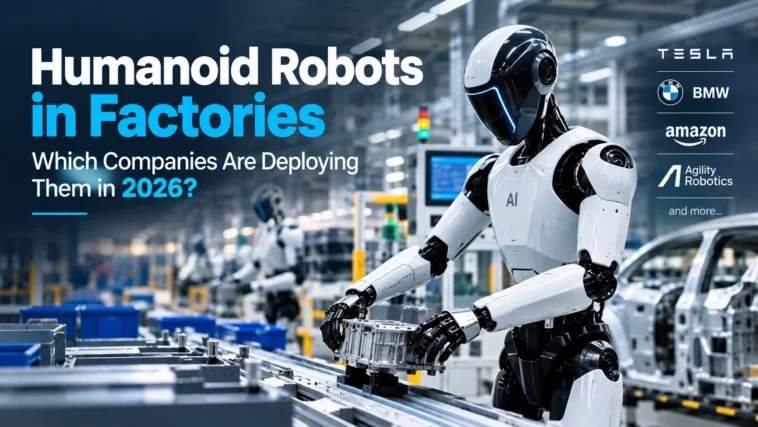
Humanoid robots stopped being a trade-show novelty somewhere in the last eighteen months. In 2026, a small but growing list of manufacturers is running bipedal, AI-powered machines on real production lines — not in demo videos, but on shifts, with output targets and safety audits attached. At the same time, the hype around humanoid robots in factories 2026 has outrun the verified data, and separating confirmed deployments from vendor projections has become its own skill.
This guide walks through what’s actually running on factory floors right now, the companies behind it, the economics driving the shift, and what the leading 2026 research and statistical reports say about where this is headed.
The 2026 Turning Point, According to the Data
The International Federation of Robotics (IFR) named humanoids one of its top five global robotics trends for 2026, noting that developers are “moving beyond prototypes” but that real industrial adoption will hinge on cycle times, energy consumption, maintenance costs, and dexterity matching human-level productivity. The IFR reports that the global market value of industrial robot installations reached an all-time high of US$16.7 billion, with humanoid robots for industrial use viewed as especially promising in environments designed for humans, with automotive manufacturing pioneering the trend and warehousing and manufacturing applications now coming into focus worldwide.
That sits on top of an already-large base of conventional industrial automation. The IFR’s World Robotics 2025 report recorded 542,076 industrial robots installed globally in 2024, more than double the figure from a decade earlier, with Asia accounting for 74% of new deployments compared with 16% in Europe and 9% in the Americas. Humanoids remain a small slice of that total, but it’s the segment IFR flags as the next major innovation category, and the organization notes that China, the world’s largest robotics market, has set specific targets for mass-producing humanoids while US and European firms announce large funding rounds.
Capital is arriving faster than deployment. Industry trackers put humanoid-specific startup funding at roughly $4.3 billion in 2025, part of a broader robotics investment wave, and a separate tally from Dealroom puts 2026 humanoid venture funding at $8.7 billion through July, with major rounds going to firms including Neura Robotics, Apptronik, Humanoid, and Robotera. Long-range forecasts vary widely by source: Goldman Sachs projects the humanoid market reaching $38 billion by 2035, Morgan Stanley projects $152 billion by 2040, and a separate Morgan Stanley report forecasts roughly 930 million humanoid units in industrial and commercial use by 2050 — with China projected to lead at over 300 million units and the US at roughly 78 million.
Which Companies Are Actually Deploying Humanoid Robots in Manufacturing?
This is where the picture gets messier than the headlines suggest. A useful independent review of company filings and earnings calls found that widely circulated deployment figures — tens of thousands of Optimus units, thousands of Figure robots — don’t hold up against what the companies themselves have confirmed on the record. That doesn’t mean nothing is happening; it means the confirmed, verifiable deployments are more modest and concentrated than the marketing suggests.
Figure AI — BMW Spartanburg (most documented deployment)
Figure’s partnership with BMW is widely regarded as the most transparent and longest-running commercial humanoid deployment. Figure 02 units have worked material handling, component insertion, and quality-check tasks on a live production line, contributing to output tracked in the tens of thousands of vehicles, logging over a thousand cumulative operating hours across multi-shift coverage. BMW has also begun a second European deployment — internally called AEON — targeting high-voltage battery assembly by the end of 2026, built around a mobile wheelbase with a self-swapping battery pack for continuous shift coverage.
Agility Robotics — Amazon and Toyota
Agility’s Digit robot handles tote and material movement inside Amazon fulfillment centers and completed a year-long commercial pilot at a Toyota facility — one of the longer continuously documented humanoid programs in the industry, with a production facility built for volume output.
Tesla — Optimus at Fremont and Gigafactory Texas
Tesla’s public messaging has been the most aggressive, and also the hardest to verify independently. On Tesla’s Q4 2025 earnings call, Elon Musk conceded that Optimus units were, in his words, “not in usage in our factories in a material way,” describing the program as still in a research and data-collection phase rather than production. Reporting through mid-2026 places initial Fremont production plans at roughly 1,000 Gen 3 units, working on cell handling, cable routing, and connector-seating tasks — alongside an acknowledgment that a meaningful share of the fleet exists to generate training data rather than finished output.
Unitree, AgiBot, and UBTECH — China’s volume lead
China’s manufacturers have taken a fundamentally different path: mass production first, dexterity refinement second. Unitree shipped roughly 5,500 humanoid units in 2025 alone — the highest volume of any producer globally — with 2026 targets in the 10,000–20,000 unit range, and its G1 model is commercially available for purchase at a price point competitive with a year of US minimum-wage labor. AgiBot has announced automotive pilot programs, and UBTECH’s Walker S units are running assembly-assist tasks inside Chinese EV factories.
Schaeffler, JAL, and the industrial supply chain
Deployment isn’t limited to automakers. In May 2026, UK robotics firm Humanoid signed a binding, phased deployment agreement with Schaeffler, one of the world’s largest automotive component suppliers, following a proof-of-concept trial completed earlier in the year — with the robots required to integrate into Schaeffler’s existing safety, IT, and cybersecurity infrastructure from day one. Outside manufacturing proper, Japan Airlines partnered with GMO AI & Robotics to trial Unitree-based humanoid platforms for baggage handling at Haneda Airport, and logistics operator GXO and industrial group Hyundai are both listed among firms running field trials.
Which Car Makers Use Humanoid Robots?
Automotive manufacturing remains the proving ground for humanoid robots, largely because it already has structured, repeatable tasks and the safety infrastructure to support close human-robot collaboration:
- BMW — Figure robots at Spartanburg (South Carolina); AEON pilot in Europe for battery assembly
- Tesla — Optimus at Fremont and Gigafactory Texas, internal use only as of mid-2026
- Toyota — completed a year-long Digit pilot with Agility Robotics
- Mercedes-Benz — early-stage pilot programs, units in the dozens rather than hundreds
- Hyundai — field trials tied to its Boston Dynamics ownership and physical-AI initiatives
- Chinese EV manufacturers — UBTECH Walker S units running assembly-assist tasks across multiple plants
Western automakers are, on the whole, still at pilot scale — programs measured in dozens of units rather than thousands — while Chinese manufacturers have moved further toward volume production, even if dexterity and task complexity still lag behind the automotive-grade precision required for tasks like welding.
What Does a Humanoid Robot Cost Per Unit in 2026?
Cost is the variable that will determine whether this becomes a genuine labor-substitution technology or stays a research exercise. According to Bain & Company’s cost analysis, humanoid unit prices fell more than 40% between 2022 and 2024. That trend has continued:
- Unitree G1: roughly $13,500 — comparable to about a year of US minimum-wage labor
- Mid-range industrial humanoids: roughly $60,000, which — running 20 hours a day over five years, including maintenance and energy costs — works out to approximately $1.64 per operating hour
- Figure and Apptronik-class platforms: pricing isn’t fully public, but sit well above the Unitree end given payload, dexterity, and battery-swap engineering
That per-hour figure is the number driving procurement interest: it undercuts fully loaded human labor costs in high-turnover, physically repetitive roles, provided the robot can actually sustain multi-shift uptime — which remains the open engineering question industry-wide.
The Labor Backdrop: Shortage, Not Just Substitution
The demand side of this story is a well-documented labor gap. Manufacturing globally is short an estimated 8 million workers, and the IFR frames the near-term humanoid opportunity explicitly as augmentation rather than replacement. The World Economic Forum’s broader labor-displacement modeling projects roughly 85 million jobs displaced by automation trends by 2030, against roughly 97 million new roles created in adjacent and emerging fields — a net positive on paper, though not evenly distributed across regions or skill levels.
What the 2026 Research Papers Actually Say
Two documents are worth flagging for anyone doing deeper diligence:
- IFR’s “Humanoid Robot” position paper (2025–2026 edition) — a free-download positioning paper covering the trends, opportunities, and current limitations of humanoid platforms, explicitly framing them as the “next big thing” in robotics while cautioning that mass adoption, particularly for household use, isn’t imminent.
- IFR’s “The Impact of Robots: Employment, Productivity and Competitiveness” (published August 2026) — a position paper reviewing current research and evidence on how robot adoption more broadly affects labor markets, business performance, and economic growth, replacing an earlier IFR paper on robots and employment.
Both are useful correctives to vendor marketing: they’re written by an industry federation with access to installation data across manufacturers, rather than any single company’s press office.
Reading Deployment Claims Critically
A recurring theme across independent reporting in 2026 is that headline deployment numbers frequently outrun what companies confirm on earnings calls or in filings. Before citing a specific unit count, it’s worth checking:
- Whether the figure comes from a company’s official disclosure (earnings call, SEC filing, press release) or a third-party estimate
- Whether “deployed” means performing production tasks, or generating training data in a live environment without contributing to output
- Whether the timeframe cited is a target (e.g., “10,000–20,000 units in 2026”) or an achieved figure
The Bottom Line for 2026
Humanoid robots have crossed from lab demonstration into paid, if narrow, industrial work this year. Figure’s BMW deployment and Agility’s Amazon and Toyota programs are the most independently verifiable examples in the West; Unitree’s shipment volume gives China the clearest lead in raw unit production. Tesla’s Optimus program generates the most attention but, per the company’s own on-record statements, remains closer to a research and data-collection effort than a production deployment. For manufacturers evaluating whether humanoids belong on their own floor, the real signal to watch isn’t funding totals or long-range forecasts — it’s confirmed multi-shift uptime on a task that used to require a human, at a per-hour cost that beats the alternative.
FAQs
Figure AI, Agility Robotics, Tesla, UBTECH, and Unitree are among the key companies involved in industrial deployments or trials.
Prices range from around $13,500 for Unitree G1 to roughly $60,000+ for advanced industrial models.
Tesla has tested Optimus in its factories, but large-scale production use has not yet been confirmed.
Automotive manufacturing is currently the leading sector.
For now, they mainly assist workers with repetitive and physically demanding tasks rather than replacing them entirely.