kiruthika
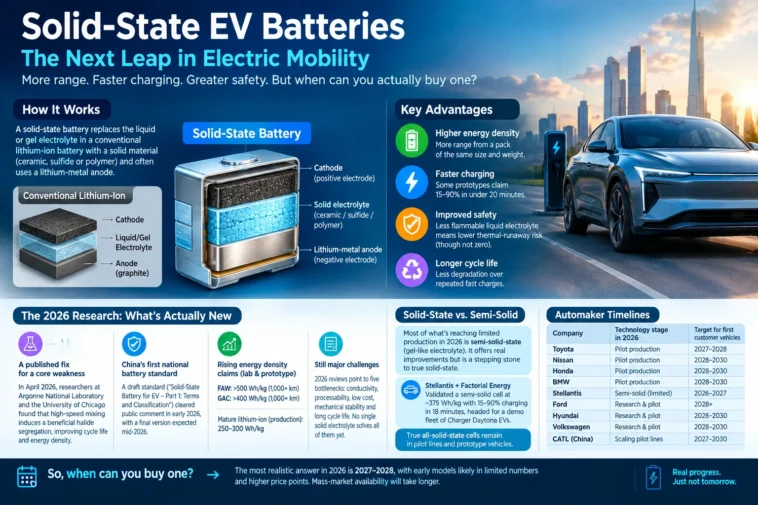
Solid-state batteries have been “three years away” for most of the last decade. In 2026, that joke is finally starting to wear thin — not because solid-state EVs are showing up in dealer lots, but because the gap between lab demonstrations and real factory output has visibly narrowed. Pilot lines are running, a national battery standard is being finalized, and a peer-reviewed breakthrough published this spring addressed one of the technology’s longest-standing weaknesses.
This guide breaks down what a solid-state battery actually is, what the latest 2026 research shows, where each major automaker stands, and — most importantly — a realistic answer to “when can I actually buy one.”
What Is a Solid-State EV Battery?
A conventional lithium-ion battery moves ions between electrodes through a liquid or gel electrolyte. A solid-state battery replaces that liquid with a solid material — typically a ceramic, sulfide, or polymer — and often pairs it with a lithium-metal anode instead of the graphite anode used in today’s EVs.
That single swap is responsible for nearly every advantage solid-state batteries promise:
- Higher energy density — more range from a pack of the same size and weight
- Faster charging — some prototypes claim a 15–90% charge in under 20 minutes
- Improved safety — removing the flammable liquid electrolyte reduces (though doesn’t eliminate) thermal-runaway risk
- Longer cycle life — less degradation over repeated fast charges
The catch is manufacturing. Solid-state cells require tolerances measured in microns, and the same interface problems that make a lab cell perform beautifully — cracking, contact loss, dendrite formation — get dramatically harder to control at gigawatt-hour scale.
The 2026 Research: What’s Actually New
A few developments from this year are worth knowing, because they explain why “2027–2028” has become the industry’s default answer rather than “2025” or “2030.”
A published fix for one of solid-state’s core weaknesses. In April 2026, researchers at Argonne National Laboratory and the University of Chicago published findings in Science showing that rapid, high-speed mixing of the solid electrolyte and cathode materials induces a beneficial halide segregation at the internal interfaces of all-solid-state cells. The result was hundreds of additional charge-discharge cycles and a meaningful energy-density gain — addressing exactly the degradation mechanism that has kept solid-state cycle life behind lithium-ion in real-world testing.
China is finalizing the first national solid-state EV battery standard. A draft standard covering terminology and classification — “Solid-State Battery for Electric Vehicle – Part 1: Terms and Classification” — cleared public comment in early 2026, with a final version expected around mid-2026. This matters more than it sounds: a shared technical definition is a prerequisite for regulators, insurers, and suppliers to treat solid-state cells as a standardized product rather than a collection of incompatible prototypes.
Energy density claims are climbing in test conditions, not yet in production. FAW has reported cell-level energy density above 500 Wh/kg in testing, enough for a claimed 1,000+ km (620+ mile) range under China’s CLTC test cycle. GAC has reported over 400 Wh/kg with a similar range claim. For comparison, mature production lithium-ion cells typically sit in the 250–300 Wh/kg range. These are real lab and prototype figures — not numbers you’ll see on a window sticker yet.
Academic reviews are converging on the same short list of unsolved problems. Multiple 2026 peer-reviewed reviews (ScienceDirect, Renewables) point to the same five bottlenecks: no single solid electrolyte yet satisfies high ionic conductivity, easy processability, low cost, mechanical stability, and long cycle life simultaneously. Progress tends to trade one property for another — a pattern that shows up repeatedly across sulfide, oxide, and polymer electrolyte research this year.
Solid-State vs. Semi-Solid: A Distinction That Matters in 2026
Most of what’s reaching limited production this year isn’t a pure solid-state battery — it’s semi-solid-state, using a gel-like electrolyte that sits between liquid and fully solid. Semi-solid cells deliver real improvements in energy density and safety over conventional lithium-ion, but they’re a stepping stone, not the end state. Stellantis and Factorial Energy, for example, have validated a semi-solid cell at roughly 375 Wh/kg with claimed 15–90% charging in 18 minutes, headed for a demo fleet of Charger Daytona EVs. True all-solid-state cells remain confined to pilot lines and prototype vehicles.
Automaker Timelines: Who’s Actually Closest
| Automaker / Company | Technology stage in 2026 | Target for first customer vehicles |
| Toyota | Pilot production running at PPES (Japan); largest solid-state patent portfolio in the industry | 2027–2028, limited premium trims |
| CATL | Semi-solid cells targeted near 2026; full solid-state later | ~2030 for full solid-state |
| BYD / FAW / Dongfeng | Prototype and cold-weather testing underway; national standard pending | 2027 limited production, ~2030 mass production |
| GAC | Reported 400+ Wh/kg cells in testing | 2027–2030 ramp |
| QuantumScape (with Volkswagen) | Targeting qualification samples in late 2026 | ~2028 vehicle integration |
| Stellantis / Factorial | Semi-solid cell validated; demo fleet planned | Near-term demo, full launch later in decade |
| Mercedes-Benz (with Factorial) | Prototype pack road-tested (~750 miles on one charge) | Early 2030s for commercial introduction |
| BMW (with Samsung SDI, Solid Power) | Demonstration vehicles in validation | 2026–2028 window, alongside Stellantis and GM |
| Nissan | Own pilot line, automated “Cobra” production equipment installed | 2028 commercial launch target |
| Honda (with Factorial) | Demonstration line running | Late 2020s |
The pattern across nearly every serious program is the same: pilot and demonstration now, a handful of expensive low-volume vehicles around 2027–2028, and mainstream affordability clustered near 2030 and beyond. Toyota is generally regarded as the closest major automaker to commercial solid-state production, largely on the strength of its patent portfolio and running pilot line — but even Toyota’s realistic first vehicles will be limited-production, premium-priced flagships, not mass-market models.
Solid-State Battery Statistics: The 2026 Snapshot
| Metric | 2026 figure |
| Solid-state cell energy density (lab/prototype) | 260–500+ Wh/kg |
| Conventional production lithium-ion energy density | ~250–300 Wh/kg |
| Estimated solid-state cell cost | $400–$800 per kWh |
| Mature lithium-ion production cost | A fraction of that, which is why solid-state stays in premium trims first |
| Fastest claimed charging (semi-solid prototype) | 15–90% in ~18 minutes |
| Global solid-state battery market size, 2025 | Roughly $1.7–2 billion (estimates vary by research firm) |
| Projected market size by early 2030s | Multiple forecasts in the $3–6.5 billion range, before broader long-term projections push toward $10 billion by 2036 |
| Typical market CAGR estimate through the early 2030s | Roughly 18–48%, depending on the research firm and scope |
| Region with largest current market share | Asia-Pacific |
Market-size estimates vary widely between research firms because “solid-state battery market” gets scoped differently — some include semi-solid and consumer-electronics cells, others count only automotive-grade fully solid cells. Treat any single headline number with some skepticism and look at the direction (steep, consistent growth) rather than the exact figure.
Solid-State vs. Lithium-Ion: Quick Comparison
| Factor | Lithium-Ion (today) | Solid-State (2026 status) |
| Energy density | ~250–300 Wh/kg, mature and consistent | 260–500+ Wh/kg in lab/prototype cells |
| Charging speed | Fast-charging widely deployed today | Faster charging claimed, unproven at scale |
| Safety | Flammable liquid electrolyte, well-understood failure modes | Non-flammable electrolyte, but new failure modes (cracking, dendrites) still being studied |
| Cycle life / longevity | Well-documented over hundreds of thousands of real-world vehicles | Promising in lab results; limited long-term field data |
| Cost | Mature, falling steadily | $400–$800/kWh, several times higher |
| Availability | Every EV on sale today | Prototypes, demo fleets, and pilot lines only through 2026 |
How Much Will Range Actually Increase?
The headline range claims circulating in 2026 — 1,000+ km (620+ miles) on a single charge — come from prototype cells tested under China’s CLTC cycle, which tends to report higher numbers than the U.S. EPA or European WLTP cycles. Translate those figures conservatively: a realistic expectation for early solid-state production vehicles is a 20–40% range improvement over an equivalent lithium-ion pack of similar size and weight, not a doubling. The bigger near-term win for most buyers will likely be charging speed and pack safety margins rather than range alone, since automakers may choose to shrink the pack rather than maximize range once solid-state cells are viable.
Which Cars Will Get Solid-State Batteries First?
Expect the first solid-state (or semi-solid) production vehicles to be:
- Limited-run, premium-priced flagship models — not mainstream trims
- Concentrated among Toyota, BYD, Dongfeng, FAW, and GAC for the earliest 2027 launches
- Demo fleets before retail sales — Stellantis’s Charger Daytona test fleet with Factorial cells is a preview of this pattern
- Priced at a significant premium, since $400–$800/kWh cell costs won’t support mass-market pricing yet
If you’re shopping for an EV in the 2026–2030 window, the realistic expectation is that you’re buying a meaningfully improved lithium-ion vehicle — better LFP chemistry, silicon-anode blends, and refined thermal management — rather than a solid-state one.
When Will Solid-State Batteries Be Available to Regular Buyers?
Based on the current public timelines across every major program:
- 2026–2027: Pilot production, demo fleets, and first small-batch semi-solid cells reach limited test vehicles
- 2027–2028: First customer-purchasable EVs with solid-state or advanced semi-solid packs, priced as low-volume flagships
- ~2030 and beyond: Mass production begins, cost parity with lithium-ion starts to close, and solid-state options spread into more mainstream segments
Every credible analyst, automaker, and peer-reviewed review published in 2026 lands on some version of this same three-stage picture. The technology is real and progressing — it’s simply progressing on a manufacturing timeline, not a marketing one.
FAQs
Not in retail vehicles. Pilot production lines and prototype/demo vehicles exist, and a national solid-state standard is being finalized in China, but no mainstream production EV ships with a true solid-state pack in 2026.
Prototype cells under favorable test cycles claim 1,000+ km, but a realistic real-world improvement for first-generation production vehicles is closer to 20–40% over an equivalent lithium-ion pack.
Toyota is widely seen as closest, targeting 2027–2028 for limited premium models. Chinese automakers (BYD, FAW, Dongfeng, GAC) and QuantumScape/Volkswagen are on similar or slightly later timelines, alongside Stellantis, Mercedes-Benz, BMW, Nissan, and Honda through partnerships with battery specialists.
Lithium-ion remains the better real-world choice today — it’s mature, well-tested, and affordable. Solid-state offers a higher performance ceiling (energy density, charging speed, safety) but isn’t yet proven at automotive scale or price.