kiruthika
Edge Computing Explained
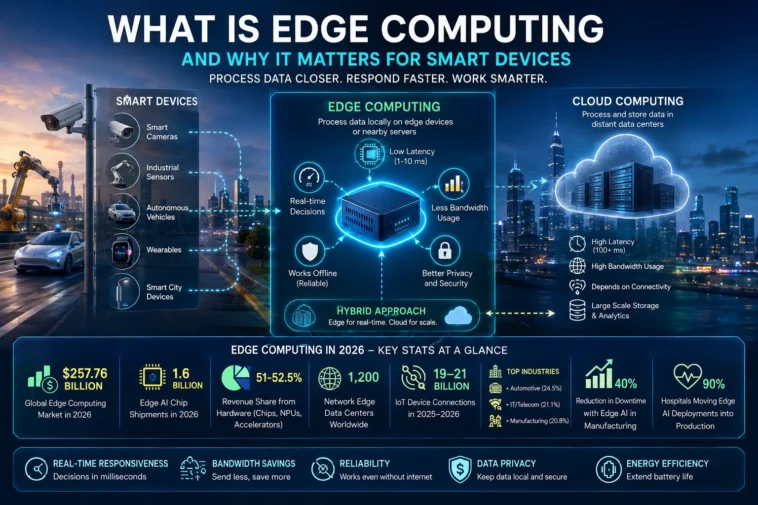
Edge computing is a distributed computing model that moves data processing and storage away from centralized cloud data centers and closer to the place where data is actually generated, a sensor, a camera, a factory machine, a car, or a smartphone. Instead of every byte making a round trip to a remote server, the “edge”, a local gateway, an on-device chip, or a nearby micro data center, does the work right there.
The idea is simple: the closer the compute is to the data source, the faster the response. For applications like safety alerts, machine control, or autonomous navigation, decisions have to happen in milliseconds, and even a brief round trip to a distant cloud region can be too slow.
Edge vs. Cloud Computing
| Cloud Computing | Edge Computing | |
| Where processing happens | Centralized, remote data centers | Local, on-device or nearby gateway/server |
| Latency | Higher (network round trip) | Very low (near-instant, often single-digit ms) |
| Bandwidth use | High, raw data sent to the cloud | Low, only filtered/summarized data sent onward |
| Best for | Large-scale storage, heavy batch analytics, training AI models | Real-time decisions, safety-critical systems, offline-capable devices |
| Reliability | Depends on network connectivity | Can keep working during network outages |
In practice, most real systems today are hybrid: edge devices handle instant, local decisions, while the cloud handles long-term storage, heavy model training, and cross-site analytics.
Edge AI Devices
“Edge AI” refers to running artificial intelligence models, especially inference, the “using” part of a trained model, directly on local hardware rather than in the cloud. This includes:
- Smart cameras that detect anomalies on a factory line without sending video to the cloud
- Autonomous vehicle sensors processing lidar/camera data in real time
- Wearables and health monitors flagging irregular vitals instantly
- Retail and smart-city sensors doing on-device analytics
This is powered by specialized low-power chips, NPUs (neural processing units), edge AI accelerators, and system-on-chip designs, that let AI inference happen with minimal energy and near-zero delay.
Why It Matters for Smart Devices
- Real-time responsiveness — safety systems, robotics, and autonomous vehicles can’t tolerate cloud round-trip delay.
- Bandwidth savings — sensors generate constant streams of raw data; processing locally and sending only summarized insights upward dramatically cuts network load.
- Reliability without connectivity — edge devices can keep functioning during network outages, which matters for industrial and medical settings.
- Data privacy and sovereignty — sensitive data (health, biometric, industrial) can be processed locally instead of leaving the premises, helping meet data-localization regulations.
- Energy efficiency at scale — energy-aware architectures that split work between device, edge, and cloud can meaningfully extend battery life on IoT hardware.
2026 Research Paper Spotlight
A relevant peer-reviewed 2026 study is “Edge AI for SD-IoT: A Systematic Review on Scalability and Latency” (MDPI, IoT journal, Vol. 7, Issue 1, published February 27, 2026). This systematic literature review examines machine-learning-based approaches for tackling scalability and low-latency challenges in software-defined IoT (SD-IoT) environments, cataloging the strategies researchers are using to keep edge AI systems fast as device counts grow.
Complementing this, a 2026-published study in the IoT journal on Intelligent Edge Computing (IEC) for transportation demonstrated a real-world urban deployment where an edge architecture achieved an average transmission latency of 15.45 ms and total end-to-end latency of about 47.9 ms across a 600-meter urban distance, using deep learning at the edge node to count vehicles at intersections in real time, a concrete illustration of how far below “cloud-speed” true edge latency can go.
Other academic work backs up the energy angle: research surveys note that edge and IoT systems designed with energy-aware partitioning of workloads between device, edge, and cloud can significantly extend device battery lifetime, which is a growing research focus as billions of battery-powered sensors come online.
Real-Time Market and Adoption Statistics (2026)
- The global edge computing market reached an estimated $257.76 billion in 2026, projected to grow to $479.97 billion by 2031 (13.24% CAGR).
- A separate market model puts the broader figure lower, at roughly $82 billion in 2026, rising to $206 billion by 2032 (18.3% CAGR) — estimates vary widely (from ~$28.5B to ~$658B) depending on how “edge computing” is scoped.
- The AI-specific edge computing market hit an estimated $29.98 billion in 2026, up 20.3% from $24.91 billion in 2025.
- Edge AI chip shipments are projected to reach roughly 1.6 billion units in 2026.
- Hardware (chips, NPUs, accelerators) makes up roughly 51–52.5% of AI edge computing revenue.
- North America leads global adoption with about 36–42% of market share, followed by Asia-Pacific (~28–30.5%) and Europe (~30% in some breakdowns).
- China is projected to host about 26% of all global network edge sites in 2026.
- Total network edge data centers worldwide are estimated to approach 1,200 by 2026.
- IoT device connections are estimated at roughly 19–21 billion in 2025–2026, on a path toward ~29 billion by 2030.
- By industry adoption of edge AI: automotive (~24.5%), IT/telecom (~21.1%), and manufacturing (~20.8%) are the largest verticals.
- In manufacturing, real-time anomaly detection running at the edge has been linked to roughly 40% reductions in downtime.
- In healthcare, an estimated 90% of hospitals have moved edge AI deployments from pilot programs into production.
Figures above are compiled from multiple 2026 industry market-research reports (Mordor Intelligence, Grand View Research, MarketsandMarkets, Statista-sourced analyses, and sector trackers); estimates vary by firm because of differing market scope definitions, so treat exact figures as directional rather than exact.
The Bottom Line
Edge computing isn’t replacing the cloud, it’s specializing the workload. Smart devices increasingly need to think for themselves, at least for the decisions that can’t wait for a network round trip. As edge AI chips get cheaper and more power-efficient, and as 5G and data-sovereignty rules push more processing toward the network’s periphery, the split between “what happens locally” and “what happens in the cloud” will keep shifting further toward the edge.
FAQs
Edge computing is a distributed computing approach that processes data closer to where it is generated, such as on a smartphone, sensor, camera, vehicle, or nearby server, rather than sending everything to a centralized cloud.
Cloud computing processes data in centralized data centers, while edge computing processes data locally or near the device generating it. Edge computing can provide lower latency, reduce bandwidth usage, and improve reliability when connectivity is limited.
Edge AI is the use of artificial intelligence models directly on edge devices or nearby computing hardware. It allows devices such as smart cameras, wearables, vehicles, and industrial machines to analyze data and make decisions without relying entirely on the cloud.
Edge computing helps smart devices respond faster, reduce data transmission, operate during network interruptions, improve data privacy, and potentially extend battery life by reducing the amount of information sent to remote servers.
No. Edge and cloud computing generally work together. Edge devices handle time-sensitive processing and immediate decisions, while cloud platforms are better suited for large-scale storage, complex analytics, AI model training, and centralized management.