kiruthika
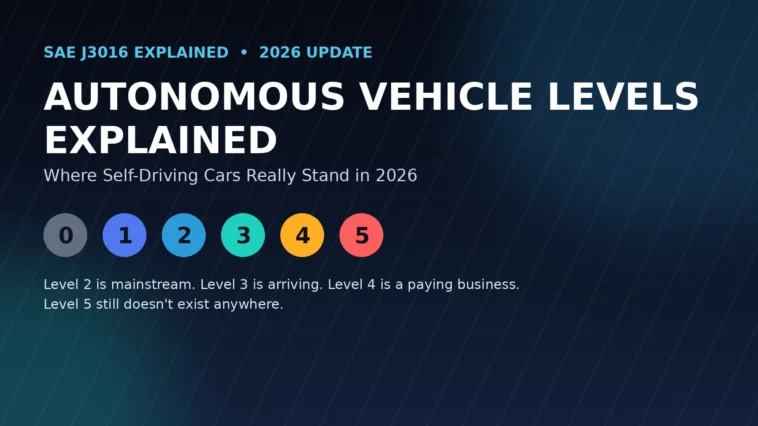
Here’s the thing almost nobody selling a car will tell you straight: as of 2026, there is still no personal vehicle you can buy anywhere in the world that drives itself with zero supervision. Not one. Yet “self-driving” gets slapped on window stickers and ad campaigns constantly, and it’s genuinely confusing.
That confusion is exactly why the SAE automation levels exist. This guide breaks down all six levels of self-driving cars, explains what each one actually means for the person behind the wheel (or not behind it), and shows you, with real, current data, exactly where Level 4 autonomous vehicles and every other level actually stand right now.
Key Highlights (Quick Facts)
- The SAE automation levels run from Level 0 (no automation) to Level 5 (full automation), under the official standard SAE J3016, jointly recognized by SAE International and the U.S. Department of Transportation.
- As of mid-2026, every personal vehicle sold to consumers is Level 2 or “Level 2+” — the driver is still legally responsible at all times, according to GreenCars’ 2026 industry review.
- Mercedes-Benz DRIVE PILOT remains the only Level 3 system certified for U.S. roads, currently approved only in California and Nevada, per Kelley Blue Book.
- Waymo operates roughly 3,000 Level 4 robotaxis across 11 U.S. cities, completing an estimated 500,000 paid rides a week, according to Presenc AI’s 2026 tracking data.
- Tesla’s Robotaxi service remains far smaller by comparison — around 44 vehicles, mainly in Austin, with most rides still carrying a human safety monitor, per Electrek’s May 2026 reporting.
- Level 5 automation does not exist as a commercial product anywhere in the world as of 2026, according to iTechGuides’ August 2026 guide to self-driving cars.
- The global autonomous vehicle market is valued anywhere from roughly $93 billion to over $360 billion in 2026, depending on the research firm’s scope and methodology — a reminder that “market size” numbers in this industry vary wildly and should be read with the source attached.
- Goldman Sachs estimates that up to 10% of global new car sales could be Level 3 vehicles by 2030, according to Synopsys Automotive’s 2026 industry brief.
The 6 levels of self-driving cars under the SAE J3016 standard.
What Are the SAE Automation Levels?
The SAE automation levels come from SAE International (the same engineering body behind hundreds of other automotive standards), working alongside the International Organization for Standardization. The official document is called SAE J3016, and it has become the global reference point that regulators — including the U.S. Department of Transportation, the EU, and China — use to define what a car is actually allowed to do on its own.
The framework splits into two broad groups:
- Levels 0-2 — “Driver Support Systems.” The human is always driving, even when the car is helping.
- Levels 3-5 — “Automated Driving Systems.” The car itself is doing the actual driving, at least under some conditions.
That 2-to-3 boundary is the single most important line in the entire framework — legally, technically, and in terms of who’s liable if something goes wrong, according to a 2026 regulatory review by TheTechTrends.
The 6 Levels of Self-Driving Cars, Explained
Level 0 — No Automation
The car might beep at you or flash a warning light, but it never actually takes control of steering, braking, or acceleration. Think of any basic vehicle without adaptive cruise control or lane-keeping — the human does 100% of the driving, 100% of the time.
Level 1 — Driver Assistance
One automated function at a time. Adaptive cruise control that manages your speed, or lane-keeping assist that nudges your steering — but never both together. Virtually every new vehicle sold in the U.S. in 2026 includes at least Level 1 features as standard equipment, according to Safe Self Drive’s 2026 breakdown.
Level 2 — Partial Automation
Now the car manages steering and speed at the same time, under certain conditions — but the driver must keep watching the road and stay ready to take over instantly. This is where most “self-driving” marketing actually lives in 2026: Tesla Autopilot, GM Super Cruise, Ford BlueCruise, and Hyundai Highway Driving Assist 2 are all Level 2 systems. The industry also uses informal “Level 2+” and “Level 2++” labels for hands-off (but still eyes-on) versions of this same level.
Level 3 — Conditional Automation
This is where things get genuinely different: the car can drive itself under specific, defined conditions without the human continuously monitoring the road. But there’s a catch — a “fallback-ready” driver must still be able to take back control within seconds when the system asks. As of 2026, Mercedes-Benz DRIVE PILOT is the only Level 3 system certified for U.S. roads.
Level 4 — High Automation
This is the level everyone means when they say “robotaxi.” No human driver is needed at all — but only inside a specific, mapped, geofenced service area under specific conditions (known as the Operational Design Domain, or ODD). Take the same vehicle outside that zone, and it simply can’t drive itself. Waymo, Tesla Robotaxi, Baidu Apollo Go, and Amazon’s Zoox are the main names operating at this level in 2026.
Level 5 — Full Automation
The finish line: a vehicle that can drive anywhere, in any condition, that a competent human driver could handle — no steering wheel or pedals required, no geofence, no exceptions. As of 2026, this remains entirely theoretical. No company has a Level 5 product, prototype fleet, or announced release date for consumers.
Level 4 Autonomous Vehicles in 2026: Who’s Actually Driving Driverless
Level 4 autonomous vehicles are the biggest real-world story in this whole industry right now, because they’re the first automation level that’s an actual, paying commercial business rather than a driver-assistance feature bundled into a car you own.
Waymo is the clear scale leader. As of mid-2026, the company operates a fleet of roughly 3,000 vehicles across 11 U.S. cities, covering about 1,400 square miles of fully driverless service — a 27% expansion in coverage over the previous year, according to Presenc AI’s 2026 tracker. Waymo has also confirmed plans to launch in its first international markets, London and Tokyo, and is targeting 1 million paid trips per week by the end of 2026.
Tesla’s Robotaxi service tells a very different story. It launched in Austin and has expanded toward a goal of seven U.S. cities in the first half of 2026, but as of the latest tracking, it runs only around 44 vehicles, and the majority of rides still include a human safety monitor in the car — meaning much of what’s currently branded “Robotaxi” doesn’t yet meet the strict definition of Level 4, according to Electrek’s reporting.
Elsewhere, Baidu’s Apollo Go is running commercial Level 4 service across more than 10 Chinese cities, including Beijing, Shanghai, and Shenzhen, while Amazon’s Zoox launched its own commercial robotaxi service in late 2025, per Presenc AI’s 2026 industry roundup.
Waymo vs. Tesla Robotaxi: verified operational data, mid-2026.
Waymo vs. Tesla Robotaxi: 2026 Comparison Table
| Metric | Waymo | Tesla Robotaxi |
| Fleet size | ~3,000 vehicles | ~44 vehicles |
| Paid rides per week | ~500,000 | Limited pilot volume |
| Service area | ~1,400 sq. mi across 11 U.S. cities | ~245 sq. mi, mainly Austin |
| Price per mile | $1.36 – $1.43 | ~$0.81 |
| Average wait time | 5.7 minutes | 15+ minutes |
| Human safety monitor | No, fully driverless | Yes, on most rides |
| Sensor approach | Lidar + radar + cameras | Cameras only |
Data compiled from Electrek and Presenc AI’s 2026 robotaxi tracking reports. Figures shift as both companies continue expanding, so treat this as a mid-2026 snapshot rather than a live count.
Level 3 Cars You Can Actually Buy Right Now
Level 3 has turned out to be the hardest step in the entire ladder — not because the technology is impossible, but because the liability question (who’s at fault if the car is driving and something goes wrong?) is genuinely difficult to solve.
As of 2026, your real options are limited:
- Mercedes-Benz DRIVE PILOT — available on the S-Class and EQS Sedan, certified for use in California and Nevada, working at speeds up to 40 mph on approved highways. Notably, Mercedes-Benz stepped back from bringing an updated Level 3 system to the redesigned 2026 S-Class in the U.S., opting instead for a Level 2++ system while it develops a next-generation Level 3 platform capable of highway speeds up to 81 mph, according to WardsAuto’s February 2026 report.
- Honda Legend (Honda SENSING Elite) — the first certified Level 3 system in the world, launched in Japan back in 2021, but limited to just 100 leased units and effectively in limbo since Honda discontinued the Legend.
- BMW Personal Pilot L3 — a low-speed Level 3 system available on the 7 Series, but only in Germany.
That’s genuinely it. No mass-market Level 3 car exists yet anywhere in the world.
Market Statistics Table
| Statistic | Figure | Source |
| Vehicles that are Level 2 or below in 2026 | Nearly all new consumer vehicles | GreenCars, 2026 |
| Certified Level 3 systems available for U.S. roads | 1 (Mercedes-Benz DRIVE PILOT) | Kelley Blue Book, 2025-26 |
| Waymo Level 4 fleet size | ~3,000 vehicles | Presenc AI, 2026 |
| Waymo weekly paid rides | ~500,000 | Presenc AI, 2026 |
| Tesla Robotaxi fleet size | ~44 vehicles | Electrek, May 2026 |
| Projected Level 3 share of new car sales by 2030 | Up to 10% | Goldman Sachs, via Synopsys, 2026 |
| Global autonomous vehicle market size, 2026 (low estimate) | ~$93.3 billion | Research and Markets, 2026 |
| Global autonomous vehicle market size, 2026 (high estimate) | ~$364 billion | Precedence Research, 2026 |
Market-size estimates vary enormously between research firms because they define “autonomous vehicle market” differently — some include only Level 3+ systems, others count the entire ADAS and sensor supply chain. Both figures above are cited directly to their source so you can judge the scope yourself.
Pros and Cons of Each Automation Level
| Automation Level | Pros | Cons |
| Level 1-2 (widely available) | Reduces driver fatigue, widely tested, affordable | Driver must stay fully engaged; easy to over-trust the system |
| Level 3 (very limited) | True hands-off, eyes-off driving in approved conditions | Only 1-3 certified systems worldwide; narrow speed and road limits |
| Level 4 (robotaxis only) | No driver needed at all inside the service area | Only works in specific, mapped cities; can’t leave the geofence |
| Level 5 (does not exist) | Would remove the human factor entirely | Not built yet; timeline is unknown even to the companies chasing it |
2026 Trends and Regulatory Shifts
A few real shifts worth understanding if you’re following this space:
- Robotaxis stopped being a novelty in 2026. Waymo alone has logged roughly 200 million fully autonomous miles as of February 2026, according to Carcody’s 2026 guide — a scale that simply didn’t exist two years earlier.
- Regulators are focused on Level 4, not Level 5. Most new autonomous vehicle regulations target robotaxi and trucking deployment specifically, because Level 3’s human-handoff problem is proving harder to solve at scale than skipping straight to full driverless operation in a limited zone, per TheTechTrends’ 2026 regulatory review.
- The U.S. approach remains fragmented. NHTSA sets national vehicle safety standards, but individual states like California and Nevada still decide which Level 3 and Level 4 systems are legal on their own roads — meaning the same car can be legal in one state and not the next.
- Some industry voices are questioning the SAE scale itself. Because the jump from Level 3 to Level 4 is such a massive engineering leap, some experts argue that a framework built around operational domains and safety data would serve the public better than a straight 0-to-5 ladder, according to Safe Self Drive’s 2026 analysis.
- China is moving fast on Level 4. Baidu’s Apollo Go already runs commercial robotaxi service across more than 10 major Chinese cities, putting China’s Level 4 rollout on a similar scale to the U.S. market.