kiruthika
Bidirectional charging lets an electric car send stored energy back to your home or the power grid. Here is how it works, which EVs support it in 2026, what it costs, and what this year’s research says about battery wear and earnings.
Short answer: Yes, if you have a compatible EV and a bidirectional charger. A typical EV battery holds several times more energy than a home battery, enough to run an average home for days during an outage. Selling power back to the grid (true V2G) is still limited to specific utility programs in 2026, but those programs are growing fast.
What is vehicle-to-grid technology?
Normal EV charging is one-way: electricity flows from the grid into your car. Vehicle-to-grid (V2G) adds a controlled return path, so the battery can push electricity back out. The car charges when power is cheap or plentiful, such as midday solar hours or late night, and discharges when demand peaks in the early evening.
The idea is older than most EVs on the road. Researchers Willett Kempton and Steven Letendre named the concept in 1997. What changed in 2026 is scale: automakers now ship bidirectional hardware in high-volume models, and utilities have started paying for it.
V2G vs V2H vs V2L: the three modes
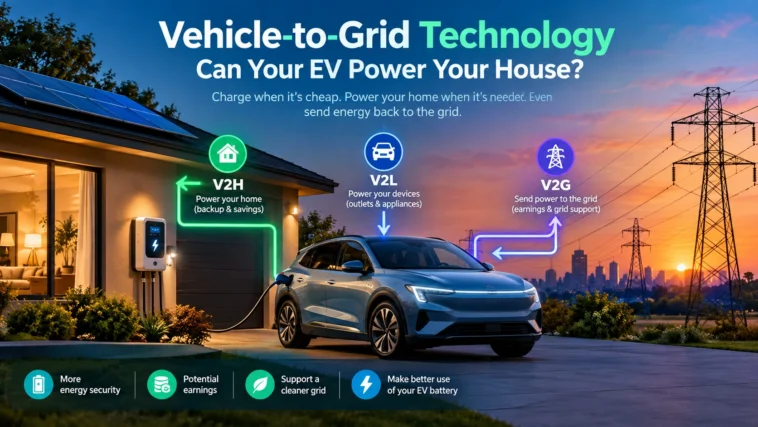
V2L (vehicle-to-load): Powers appliances plugged into outlets on the car. It needs no extra hardware beyond the car, sometimes an adapter cable. It is widespread in 2026.
V2H (vehicle-to-home): Sends power to your home’s electrical panel, usually during outages. It needs a bidirectional charger plus a transfer switch or gateway. It is available now for supported vehicles.
V2G (vehicle-to-grid): Sends power to the utility grid in exchange for payment. It needs a bidirectional charger, a utility connection and an enrolled program. It is still in pilots and early programs.
All three rely on the same bidirectional capability. The difference is how far the electricity travels and who has to approve it. V2H keeps energy inside your house, and the gateway isolates your home from the grid during an outage so no power flows back onto utility lines. V2G needs the utility’s permission because you are exporting onto shared infrastructure.
V2G in numbers: 2026 statistics
- About 630,000 bidirectional-capable EVs are on US roads, across about 14 of roughly 70 models (Bloomberg, via Axios, February 2026).
- GM alone sold more than 246,000 EVs with bidirectional capability in 2025 (Axios, February 2026).
- V2G-capable EVs could cut US grid costs by up to $7 billion per year by 2030 (E3 report, July 2026).
- Only 12–43% of EVs would need to take part to cover global short-term grid storage demand (Nature Communications).
How big is the V2G market in 2026?
Market sizing depends heavily on what each research firm counts, so treat any single figure with care. The spread across 2026 reports is large:
- Meticulous Research: $8.75 billion in 2026, rising to $48.65 billion by 2036 (18.7% annual growth).
- Precedence Research (US only): $1.85 billion in 2025, rising to $30.84 billion by 2035 (32.5% annual growth).
- Coherent Market Insights: $511 million in 2026.
- Fortune Business Insights: $18.1 million in 2026, rising to $93.8 million by 2034 (22.8% annual growth).
The gap comes down to scope. Broad definitions include chargers, software and fleet services; narrow ones count only grid-service revenue paid to vehicles. Every firm agrees on direction, though: double-digit annual growth. Europe leads in 2026 thanks to policy support in Germany, the UK and the Netherlands, and commercial fleets are the largest early segment.
Which EVs support vehicle-to-grid and V2H?
As of mid-2026, these are the main bidirectional options. Compatibility depends on model year and the exact charger, so confirm with the manufacturer before buying.
- Chevrolet Silverado EV and GMC Sierra EV: Home backup up to 10.2 kW with the GM Energy V2H bundle. Grid export through utility pilots.
- Chevrolet Equinox EV, Blazer EV and Cadillac Lyriq: Home backup with the GM Energy V2H bundle. Grid export through utility pilots.
- Ford F-150 Lightning: Home backup up to 9.6 kW. Ford discontinued its Charge Station Pro in 2026, but existing owners keep the capability.
- Tesla Cybertruck: Home backup with the Powershare gateway. Paid grid export in Texas and California.
- Kia EV9: Home backup with the Wallbox Quasar 2 charger.
- Volvo EX90 and Polestar 3: Home backup with the dcbel Ara home energy station.
- Nissan Leaf and Mitsubishi Outlander PHEV: Home backup with CHAdeMO bidirectional chargers. Grid export through older programs.
Two notable gaps remain. Tesla’s Model Y Performance has bidirectional-capable hardware but only offers outlet power (V2L), and Lucid has no certified home backup option.
Outside the US:
- Volkswagen and its Elli energy brand are launching a consumer V2G package in Germany in Q4 2026.
- Mercedes-Benz is enabling bidirectional charging on the new electric GLC and CLA in Germany, France and the UK.
- Nissan is bringing V2G to selected UK models this year.
Bidirectional EV charger cost in 2026
- GM Energy PowerShift charger plus V2H enablement kit: $1,999 plus $6,299, with installation extra. GM is planning a lease option.
- Wallbox Quasar 2: about $6,440.
- dcbel Ara home energy station: about $9,999, with built-in rooftop solar input.
- Typical full V2H system, installed: 4,000–10,000. Older 100-amp electrical panels may need an upgrade to 200 amps.
- Stationary home battery, for comparison: 10,000–16,000 installed, usually storing about 13.5 kWh.
The comparison with a home battery is the core of the value case. A popular wall-mounted home battery stores about 13.5 kWh, while many EVs carry 75–130 kWh. GM says a fully charged Silverado EV could run a home for roughly three weeks under light use.
In the US, the 30% federal charger tax credit has historically covered bidirectional equipment, but eligibility rules have changed, so check current status with a tax advisor.
Quick example: An 85 kWh battery with 20% kept in reserve for driving gives about 68 kWh of usable energy. A home using 30 kWh a day would run for about 2.3 days. A home using 10 kWh a day would run for nearly a week.
What 2026 research says
The biggest question owners ask is whether V2G wears out the battery. Earlier lab work, notably a 2017 University of Hawaii study, found that sending power to the grid twice a day sharply increased capacity loss. Newer work using real driving data shows a more mixed picture.
The potential and viability of V2G for California EV drivers
arXiv 2603.10880, March 2026. University of Michigan and Toyota Research Institute.
The team analysed real usage data from 315 Toyota bZ4X vehicles in California and grouped drivers into four profiles. Their V2G schedule discharged at 9.6 kW between 6 and 9 PM, never below 50% charge, then recharged by 4 AM.
Average energy each profile could send to the grid per year:
- Daily Charger (26% of drivers): 1,259 kWh, worth about $407 a year at proposed utility rates.
- EV as second car (17% of drivers): 576 kWh.
- Threshold Charger, who charges only when needed (38% of drivers): 204 kWh.
- Public Charger, who relies on public fast chargers (19% of drivers): 111 kWh.
The battery finding is the headline. Some battery types wear mainly from sitting at a high charge level. For these, V2G caused negligible extra wear and sometimes slightly improved capacity, because the battery spent less time full. For LFP-type batteries, which wear mainly from charge-discharge cycles, wear did increase. Even so, it was only about 0.7% extra capacity loss over 10 years for the heaviest users.
AI control of V2G fleets with battery wear limits
Scientific Reports, 3 June 2026. DOI 10.1038/s41598-026-55471-3.
This paper proposes an AI control system in which each EV charger acts as an independent agent after shared training. It builds battery wear limits directly into each decision. That lets groups of EVs cut demand peaks, balance grid frequency and store excess solar without overworking individual batteries.
Vehicle-to-grid impact on battery degradation and V2G compensation
Applied Energy, vol. 377. Sagaria, van der Kam and Boström.
A full-lifetime simulation found V2G raised the battery degradation rate by 9–14% over 10 years. Normal aging over time still caused most of the wear. The authors use this to estimate how much utilities should pay owners to cover the added wear.
EV batteries alone could satisfy short-term grid storage demand by 2030
Nature Communications. Xu et al., Leiden University and NREL.
This is still the most-cited result on V2G’s potential for the whole grid. It counts both V2G and retired EV batteries. Participation of only 12–43% of EVs could meet global short-term storage needs as early as 2030 in most regions. The International Energy Agency has cautioned that EV storage is promising but not a complete solution for net-zero grids.
Real-world programs launched in 2026
- Texas: Tesla started Powershare Grid Support for the Cybertruck in February 2026 in the CenterPoint Energy and Oncor areas of Houston and Dallas.
- California: Regulators approved PG&E’s V2X program on 20 April 2026.
- Massachusetts: The ConnectedSolutions program, which paid home battery owners more than $5.4 million in 2025, is adding V2G capacity.
- Netherlands: Utrecht’s We Drive Solar shared-car fleet was presented at Power2Drive 2026 as Europe’s first large-scale V2G deployment.
India is also moving:
- In May 2026, the India Smart Grid Forum, with the University of Delaware, completed South Asia’s first AC V2G demonstration using four retrofitted Tata Nexon EVs. It noted that AC V2G equipment costs much less than DC systems.
- Kerala’s electricity board and IIT Bombay are running a field pilot that stores daytime solar in EVs and releases it during the evening peak.
- The Central Electricity Authority has a committee drafting guidelines for EVs sending power back to the grid.
Pros and cons of V2G and V2H
Benefits
- Days of backup power from a battery you already own.
- Payments from utility programs, a few hundred dollars per year in modelled cases.
- Stores cheap solar or off-peak power for evening use.
- Smart schedules can limit or even reduce battery aging.
- Helps the grid absorb renewable energy and delay costly upgrades.
Drawbacks
- 4,000–10,000 installed, plus a possible panel upgrade.
- Grid export only works where a utility program exists.
- Charger lock-in: each car brand often needs specific hardware.
- LFP batteries see some extra wear from the added cycles.
- Warranty terms on grid export vary by automaker.
The bottom line
In 2026, using your EV to power your home is a practical, commercially available option for owners of supported vehicles. Getting paid to power the grid is real but depends on where you live. The research has also shifted: well-designed charging schedules show little battery penalty, and in some cases a small benefit. If you are buying an EV in the next year, put bidirectional support on your checklist; it is quickly becoming a standard feature.
Related reading: Which EVs support vehicle to grid · Bidirectional EV charger cost · V2G vs V2H explained
Sources
- Wong et al., “The potential and viability of V2G for California BEV drivers,” arXiv, 2026: https://arxiv.org/html/2603.10880v1
- “Degradation-constrained multi-agent reinforcement learning for V2G optimization,” Scientific Reports, 2026: https://www.ncbi.nlm.nih.gov/pmc/articles/PMC13470202/
- Sagaria et al., “Vehicle-to-grid impact on battery degradation and estimation of V2G economic compensation,” Applied Energy: https://www.astronomy.scar.org/publications/2025/vehicle-to-grid-impact-on-battery-degradation-and-estimation-of-v2g-economic-compensation/
- Xu et al., “Electric vehicle batteries alone could satisfy short-term grid storage demand by as early as 2030,” Nature Communications: https://doaj.org/article/f3100fb6617b4e42b7eb5cb7c8c5f3b0
- Axios, GM lease program and bidirectional EV statistics, February 2026: https://www.axios.com/2026/02/19/gm-ev-home-charging
- pv magazine USA, E3 report and ConnectedSolutions V2G, July 2026: https://pv-magazine-usa.com/news/page/1218/
- The ChargePort, V2H compatible cars 2026: https://thechargeport.com/v2h-compatible-cars
- The ChargePort, bidirectional EV charging reference: https://thechargeport.com/v2h-v2g
- SurgePV, bidirectional charger selection guide 2026: https://www.surgepv.com/blog/bidirectional-ev-charger-selection-guide
- Jouleio, bidirectional charging costs: https://jouleio.com/blog/bidirectional-charging/
- Meticulous Research, V2G market forecast: https://www.meticulousresearch.com/product/vehicle-to-grid-market-6416
- Precedence Research, US V2G market forecast: https://www.precedenceresearch.com/table-of-content/3738
- Fortune Business Insights, V2G market forecast: https://www.fortunebusinessinsights.com/markt-f-r-fahrzeug-zu-gitter-v2g–107673
- CAR magazine, Nissan V2G for 2026: https://carmagazine.co.uk/car-news/industry-news/nissan/vehicle-to-grid
- India Smart Grid Forum (ISGF), South Asia V2G demonstration, May 2026: https://english.punjabkesari.com/business/south-asias-first-ever-vehicle-to-grid-v2g-demonstration-led-by-isgf-in-collaboration-with-its-technology-and-utility-partners/
- Bioenergy Times, Kerala V2G pilot with IIT Bombay: https://bioenergytimes.com/kerala-launches-indias-first-field-level-vehicle-to-grid-pilot-with-iit-bombay/
- Charged EVs, University of Hawaii V2G degradation study: https://chargedevs.com/newswire/new-study-finds-v2g-discharging-harmful-to-ev-batteries/