kiruthika
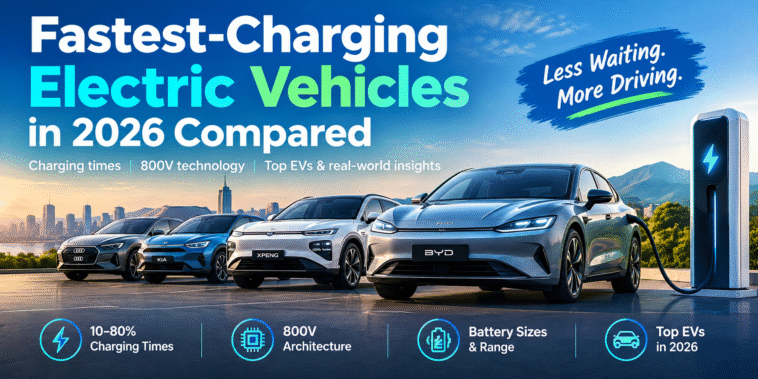
Range anxiety used to be the main reason people didn’t buy an EV. In 2026 the worry has changed. Most new EVs go far enough, so the question now is how long you’ll be standing at a charger halfway through a road trip.
The good news is that the gap between “refuel” and “recharge” is closing quickly. The bad news is that brochure numbers can mislead. A car advertised at 400 kW might spend less time on the charger than a 240 kW rival, or it might not. It depends on battery size, the shape of the charging curve, and the charger you actually plug into.
This guide compares the quickest-charging EVs you can buy in 2026, explains why 800-volt architecture matters, and includes the latest statistics and research, so you can see which numbers matter.
Quick Answer: Which EV Charges Fastest in 2026?
If you only look at mass-produced cars sold in global markets, BYD’s Han L and Tang L are in a category of their own. BYD launched its Super e-Platform in March 2025 with a charging power of 1 megawatt (1,000 kW) and a peak charging speed of 2 kilometers per second, adding 400 km of range in 5 minutes of charging. The catch is that it is currently deployed on select models at BYD-owned Megawatt Flash stations in China.
Among cars you can actually buy in Europe and North America, the leaders cluster between 12 and 21 minutes for a 10–80% charge. The current leaders take 12–18 minutes: XPENG G6 (~12 min), Audi e-tron GT (~16 min), Kia EV6 (~17 min), and Hyundai IONIQ 5 and 6 (~18 min).
EV Charging Speed Comparison Chart (2026)
The figures below are best-case 10–80% times from manufacturers and independent testers. They assume a preconditioned battery and a charger that can deliver the car’s full peak power.
| Rank | Vehicle | Architecture | Peak DC Power | 10–80% Time | Battery (usable, approx.) |
| 1 | BYD Han L / Tang L (China) | 1,000V | 1,000 kW | 10–70% in ~6 min (BYD claim) | Varies |
| 2 | Xpeng G6 | 800V | High (5C-class) | ~12 min | Varies by trim |
| 3 | Xpeng G9 | 800V | 453 kW | ~13 min | 93.1 kWh |
| 4 | Audi e-tron GT | 800V | 320 kW | ~16–18 min | ~97 kWh |
| 5 | Porsche Taycan (2025+) | 800V | 320 kW | 18 min | 105 kWh (Performance Battery Plus) |
| 6 | Hyundai Ioniq 5 / Ioniq 6 / Kia EV6 / Genesis GV60 | 800V (E-GMP) | ~235–240 kW | ~17–18 min | 77–84 kWh |
| 7 | Lucid Gravity | 924V | 400 kW | ~19 min | 123 kWh |
| 8 | Volvo ES90 | 800V | 300+ kW | ~20 min | ~106 kWh |
| 9 | BMW iX3 (Neue Klasse) | 800V | 400 kW | ~21 min | 108.7 kWh |
| 10 | Polestar 3 (800V update, not yet in US) | 800V | 350 kW | ~22 min | Varies |
Times can double in cold weather, at crowded sites, or on older 400V hardware.
The Top Fast-Charging EVs in Detail
1. BYD Han L and Tang L: The Megawatt Benchmark
BYD built a charging system around the car, not just a faster plug. The platform integrates the battery, motor, power supply system, and even the air conditioning into a unified 1000V ecosystem, and BYD reduced the battery’s internal resistance by 50%. According to official BYD data, the Han L can charge from 10% to 70% in just 6 minutes, and to 100% in 20 minutes.
BYD then pushed further. Its latest Blade Battery 2.0 targets up to 1.5 MW, with 10% to 70% in 5 minutes and 10% to 97% in 9 minutes at room temperature, and 20% to 97% in 12 minutes after 24 hours at −30°C. One caution: these newer figures should not be backdated to every Super e-Platform vehicle or charger.
The network is growing fast. BYD announced on April 1, 2026, that it deployed its 5,000th Flash Charger in China, up from 4,239 as of March 5, 2026, and it aims to build 20,000 Flash Charging stations in China by the end of 2026, plus 6,000 outside China starting from Europe in mid-2026.
2. Xpeng G6 and G9: China’s Fastest in Europe
Xpeng is the quickest brand you can actually buy in Europe right now. The Xpeng G9 set the European record for charging speed at a public charging station in 2026. With a peak power of 453 kW and 800V architecture, it can charge from 10% to 80% in about 13 minutes with its 93.1 kWh battery. The smaller G6 is even quicker at around 12 minutes.
3. Porsche Taycan and Audi e-tron GT: The Sustained-Power Champions
The Taycan was the first volume EV to launch with 800V architecture, back in 2019, and it still sets the pace for Western brands. With the 2025 update, it can be charged at up to 320 kW, 50 kW more than before, and it can sustain more than 300 kW for up to five minutes. This cut the 10–80% time by just under four minutes to 18 minutes, despite a 12 per cent increase in battery capacity.
Real-world results do vary. One long-term owner reports that the 2026 Taycan typically charges from 10% to 80% in 20–25 minutes under favorable real-world conditions, and points out that public fast charging is inconsistent due to network reliability, power sharing, and station issues, not vehicle limitations.
The Audi e-tron GT shares the J1 platform and 800V charging hardware with the Taycan, with a slightly less aggressive thermal management that means a touch more curve roll-off near 80%.
4. Hyundai Ioniq 5, Ioniq 6, Kia EV6 and Genesis GV60: The Real-World Winners
These cars don’t have the biggest peak numbers, but they’re some of the best at real-world charging. When Edmunds tested the real-world charging speed of EVs, it found that Hyundai and Kia EVs charged the quickest.
The secret is consistency. The Ioniq 6 and its E-GMP siblings post 18-minute 10–80% times because they share the same 800-volt platform. Peak rate is 235 kW but the rate is sustained. For value, this is the group most buyers should look at first.
5. Lucid Gravity: The Highest Peak in the US
Lucid’s 924-volt architecture peaks at 400 kW, the highest of any production EV, and pulls a 19-minute 10–80% on the 123 kWh pack. With a 350 kW charger, the Gravity adds about 200 miles in 15 minutes. It takes slightly longer than a Taycan, but it’s filling a much larger battery, so it adds more miles per stop.
6. BMW iX3: Europe’s New Standard
The first Neue Klasse model changed the picture for European brands. The second-generation iX3 easily surpasses the previous European champion, the Porsche Taycan (maximum 320 kW), peaking at 400 kW. BMW USA lists up to 400 kW DC charging, which can take you from 10-80% in just 21 minutes, and says you can add 170-185 miles of range in 10 minutes.
The peak doesn’t last long, though. The iX3 won’t sustain peak charging power for more than 3-5 minutes. After that, the rate will begin to taper. Even so, one test in Spain showed the car still managed to add 21 kWh of energy in just five minutes, averaging about 250kW for the session.
7. Polestar 3, Volvo ES90 and Mercedes CLA
Polestar’s big update deserves a mention. The old 400V battery pack was ditched in favor of an 800V battery, with a new peak of 350 kW and a 10-to-80% session time of 22 minutes. However, the new Polestar 3 is not yet on sale in the U.S.
Volvo’s ES90 is the brand’s first EV with 800V architecture. It supports over 300 kW of power, charging from 10% to 80% in 20 minutes. The Mercedes CLA, also on 800V, is quoted at a 10–80% charge in just 24 minutes.
800-Volt EV List 2026: Why Voltage Matters
Almost every car on this list uses a high-voltage architecture, and that’s no accident. The fastest-charging EVs in the United States run at 800 volts or more, and the charging speed leaders can bring their batteries from 10% to 80% in under 20 minutes.
The physics are simple. Power equals voltage times current. Doubling the voltage lets a car take in twice the power without doubling the current, and current is what creates heat in cables and cells. Less heat means the car can keep charging hard for longer.
Notable 800V+ EVs on sale in 2026: BYD Han L and Tang L (1,000V, China), Lucid Air and Gravity (924V), Porsche Taycan and Macan Electric, Audi e-tron GT and Q6 e-tron, Hyundai Ioniq 5, Ioniq 6 and Ioniq 9, Kia EV6 and EV9, Genesis GV60 and Electrified GV70, BMW iX3, Mercedes CLA, Volvo ES90, Polestar 3 (updated), and Xpeng G6 and G9.
There’s a practical trade-off to keep in mind. 800-volt platforms only pay off if you regularly use compatible high-power chargers. Compatibility with older stations also matters. BMW stressed that even though the iX3 runs at 800 volts, it is staying compatible with 400V stations, which was a response to an early controversy around the Mercedes CLA.
2026 Statistics: The Fast-Charging Reality Check
The International Energy Agency’s Global EV Outlook 2026, published in May, gives useful context for all these headline numbers.
The market is big and still growing. Electric car sales grew by 20% globally to exceed 20 million in 2025, meaning one-quarter of all new cars sold were electric. Looking ahead, the IEA expects global electric car sales to rise to around 23 million in 2026, or about 28% of total car sales worldwide.
Very few EVs can use the fastest chargers. This is the most surprising statistic. In 2025 there were roughly 160 battery electric car models that could charge at more than 150 kW; for speeds above 250 kW, the number drops to 50 out of 670 models, or only 4% of all electric cars sold since 2010. The IEA’s summary puts it plainly: cars able to use chargers above 250 kW represent less than 5% of the vehicle stock, but sales are growing alongside the expansion of ultra-fast and megawatt-scale chargers.
Charging infrastructure is catching up. Nearly 1.8 million public charging points were added in 2025, an increase of more than 33%, bringing the global total to more than 7 million. Charger speeds are rising as well: the average speed of charging points worldwide rose 15%, from just over 40 kW in 2024 to nearly 50 kW in 2025.
Most people still rarely fast-charge. Survey data indicates that EV owners worldwide charge privately almost 75% of the time and at public fast chargers only 10% of the time. Fast charging also costs more. According to the IEA, public fast charging can be up to 240% higher than residential prices, so exclusively using public fast charging would result in higher running costs than a gasoline car.
What 2026 Research Says About Fast Charging and Battery Health
Buyers worry that frequent fast charging wears out the battery. The latest data says the worry is valid but often overstated.
Geotab EV Battery Health Study (January 2026). This is the largest real-world dataset published this year. Geotab analyzed battery health data from more than 22,700 electric vehicles across 21 makes and models. The findings:
- The average annual degradation rate was 2.3%, compared to 1.8% in Geotab’s 2024 findings, reflecting a growing reliance on high-power DC fast charging.
- Vehicles that relied heavily on DC fast charging above 100 kW degraded at up to 3.0% per year, compared with around 1.5% for vehicles that mainly used AC or lower-power charging.
- Vehicles in hotter regions degraded around 0.4% faster per year than those in mild climates.
The overall conclusion is reassuring: an average of 2.3% per year suggests about 81.6% state of health after eight years.
Battery chemistry makes a big difference. A peer-reviewed study in the Journal of Power Sources modeled the long-term cost of heavy fast charging. In the most extreme scenario (over 90% fast charging, full voltage range), average pack replacement costs ranged from $0 for LFP (no replacements) to $27,000 for NMC and $210,000 for NCA. Limiting fast charging to roughly 20–80% of capacity reduced lifetime replacement costs to $0 for NMC. The practical takeaway is that if you fast-charge often, an LFP battery or a strict 80% charging cap will protect your pack.
Cell design research continues. Academic work in 2026, such as a Chalmers University of Technology study on optimizing battery cell design for energy density, fast charging, and degradation together, funded by the Swedish Research Council, shows that engineers are treating charging speed and battery life as a single design problem rather than trading one off against the other.
How to Get the Fastest Charge in Real Life
Hardware is only half the story. Here’s what helps most in practice.
Precondition the battery. Use the car’s built-in navigation to route to a fast charger so it can warm or cool the pack beforehand. As BYD’s own guidance notes, its Flash Charge only hits peak rates if the battery is preheated or cooled to 25–30°C, and the same principle applies to every EV.
Arrive low and leave at 80%. Charging is fastest at a low state of charge. Most fast-charging sessions touch peak power for under 90 seconds. What decides whether your stop is 18 minutes or 35 is how aggressively the car tapers as the battery fills.
Match the charger to the car. An 800V car on a 150 kW, 400V station will charge nowhere near its advertised speed. Look for 350 kW stations from networks like Ionity, Electrify America, or Tesla’s V4 Superchargers.
Watch the curve, not the peak. The Ioniq 5 holds 200+ kW for a remarkable 12 minutes, while many 400V cars rated at 250 kW peak are down to 100 kW by 40% state of charge.
Frequently Asked Questions
What is the fastest-charging EV for 10 to 80 percent in 2026?
In China, BYD’s Han L and Tang L lead with megawatt charging. In Europe, the Xpeng G6 (~12 minutes) and G9 (~13 minutes) lead. In the US, the Porsche Taycan, Hyundai/Kia E-GMP cars, and Lucid Gravity are the quickest, at 18–19 minutes.
Is 400 kW charging better than 240 kW?
Not always. A car that holds 230 kW for most of a session can match or beat a 400 kW car that only peaks briefly. Compare 10–80% times and miles added per 10 minutes instead of peak kW.
Does fast charging ruin EV batteries?
No. Frequent high-power DC charging roughly doubles yearly capacity loss compared with mostly home charging, according to Geotab’s 2026 data. Most packs still keep more than 80% of their capacity after eight years.
Will megawatt charging come to Europe and the US?
BYD is expanding Flash Charging into Europe from mid-2026. There’s no confirmed US timeline yet.
The Bottom Line
The fastest-charging EV for you isn’t always the one with the biggest number on the spec sheet. If you live in China, BYD’s megawatt system is years ahead. In Europe, Xpeng and the new BMW iX3 lead the pack. In the US, Hyundai and Kia’s E-GMP cars give the best mix of real-world speed, price, and consistency, with Porsche and Lucid for buyers with bigger budgets.
Every car on this list turns a charging stop into roughly a coffee break. By this time next year, that break could be even shorter.