kiruthika
Remember when a “smart” watch just told you how many steps you’d taken and left it at that? Yeah, those days are gone.
In 2026, the little device on your wrist (or, increasingly, your finger) can flag an irregular heartbeat, estimate how well you slept last night down to the minute, and nudge you toward better habits before you even realize you need them. It sounds a little sci-fi. It isn’t anymore.
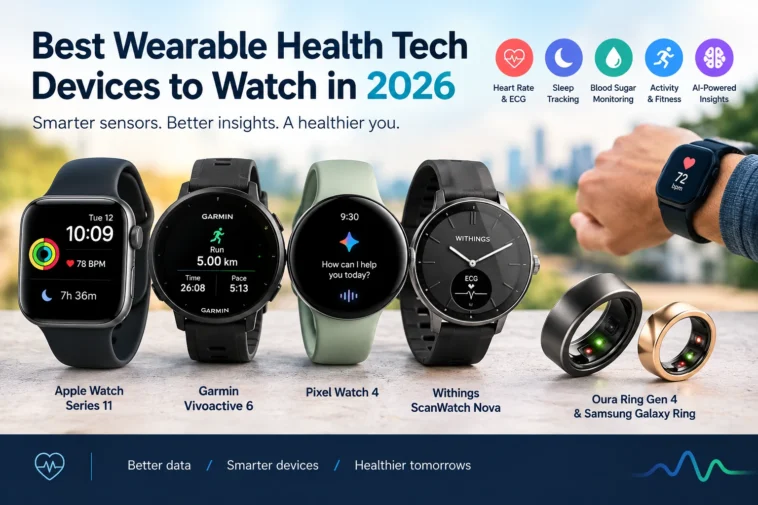
If you’re trying to figure out what’s actually worth buying this year, here’s the short version: smart rings like the Oura Ring Gen 4, Samsung Galaxy Ring, and Ultrahuman Ring Air are winning at sleep and recovery. Flagship smartwatches, the Apple Watch Series 11, Garmin Vivoactive 6, and Pixel Watch 4, still do the heaviest lifting for all-day health tracking. And minimally invasive glucose monitors like Dexcom Stelo and the newly cleared Biolinq Shine are changing what “watching your blood sugar” even means, whether or not you have diabetes.
But the more interesting story isn’t any single gadget. It’s what’s happening underneath all of them, so let’s start there.
Why 2026 feels different: the numbers behind the hype
I’ll be honest, “the market is growing” is one of the most boring sentences you can put in a tech article. But stick with me for a second, because the scale here is genuinely surprising.
- The global wearable technology market sits somewhere between $96 billion and $105 billion in 2026, depending on which analyst firm you ask, and it’s projected to grow 12% to 17% every single year through the early 2030s (Grand View Research, Fortune Business Insights).
- Wearable medical devices specifically are growing even faster than the category as a whole. Grand View Research pegs that slice at $68.1 billion in 2026, on a path to hit $330.5 billion by 2033. That’s nearly 30% annual growth, which is an enormous number for anything involving hardware.
- 63% of wearables launched recently ship with AI-driven health analytics baked in, and 41% now include ECG monitoring. A few years ago, ECG on your wrist felt like a novelty. Now it’s close to standard.
- Smart ring shipments alone are expected to jump from about 2.31 million units in 2025 to 3.23 million by 2028.
- Nearly half of U.S. adults (46%) now wear a smartwatch, and healthcare wearable adoption among people over 50 has climbed to about 34%. That last stat is the one that actually surprised me. This isn’t just a young, tech-obsessed crowd anymore. It’s your parents, too.
Put simply: wearables stopped being a fitness accessory somewhere in the last year or two and quietly became part of how a lot of people manage their actual health. Manufacturers know it, and the money is following.
What the newest research actually says (not just the marketing)
Here’s where I want to slow down, because most “best wearables” roundups skip this part entirely, and it matters.
A systematic review published in JMIR mHealth and uHealth in January 2026 took a genuinely rigorous look at the clinical evidence behind wearable sensors. Following PRISMA guidelines (the gold standard for how these reviews are supposed to be done), the researchers started with over 4,200 studies and whittled that down to 30 that actually met their bar for clinical or real-world evidence.
Their verdict? Cautiously optimistic. Wearable sensors show real promise for tracking mobility, assessing disease risk, and supporting rehabilitation. But the researchers were blunt about a real gap: there’s still no standard way to place these sensors on the body or process the data they collect, which makes it hard to compare devices across brands, or even across studies of the same device. Their recommendation was more large-scale, longer-running research and more consistent machine learning pipelines before wearables can be fully trusted for actual clinical decisions.
What does that mean for you, standing in front of a wall of options? It means the wearables on this list are genuinely good at spotting patterns and nudging you toward a conversation with your doctor. They’re not a replacement for a diagnosis, and nobody credible in this space is claiming otherwise.
Best smartwatches for comprehensive health tracking
If you only want one device, a smartwatch is still the safest bet. You get health sensors, GPS, and a screen you can actually glance at mid-run, all in one place.
- Apple Watch Series 11 is still the pick for iPhone owners, and for good reason. Heart rate monitoring, ECG, blood oxygen, detailed sleep stages, and menstrual cycle insights are all here, wrapped in the smoothest software of the bunch.
- Garmin Vivoactive 6 keeps getting crowned the best all-around fitness tracker for 2026, and it earns it. Onboard satellite connectivity, a genuinely bright AMOLED screen, and battery life that doesn’t panic you.
- Pixel Watch 4 is the Android answer, mixing Fitbit’s tracking chops with Gemini AI for coaching that feels a bit more personalized than a generic “you should walk more” nudge.
- Withings ScanWatch Nova is the one to look at if charging every night annoys you. It runs about 30 days per charge and still tracks heart rate and SpO2 continuously in the background.
Battery life used to be the single biggest complaint about smartwatches, and it’s still not solved industry-wide, but 2026 models are finally chipping away at it with smarter sensor scheduling and, in a few cases, solar or kinetic charging.
Best smart ring for health tracking in 2026
Rings had a real moment this year. What used to be a niche curiosity turned into a genuine three-way fight, and honestly, it’s made all three products better.
- Oura Ring Gen 4 is still the one to beat for sleep architecture and HRV data, packed into a titanium band that weighs less than 6 grams. You forget you’re wearing it.
- Samsung Galaxy Ring makes the most sense if you’re already deep in the Samsung ecosystem. The integration with Samsung Health is seamless in a way third-party devices just can’t match.
- Ultrahuman Ring Air leans hard into metabolic health, and it pairs particularly well with continuous glucose monitoring if you want recovery and blood sugar data living in the same app.
None of them have a screen, GPS, or real-time workout tracking, and that’s the trade you’re making. Rings are recovery and baseline health tools, not fitness watch replacements. A lot of the more committed users I’ve seen just wear both: a ring for sleep and recovery, a watch for workouts. Expect 5 to 7 days of battery life and a $299 to $399 price tag for the top models.
Best wearable glucose monitors in 2026
This is where things get genuinely exciting, and also where a lot of marketing gets ahead of what the science can actually support. Worth reading carefully.
Minimally invasive continuous glucose monitors, or CGMs, are the most clinically validated option out there today. Dexcom Stelo, FreeStyle Libre 3 Plus, and Biolinq Shine all use a small sensor inserted just under the skin. Dexcom Stelo is notably available over the counter now for adults 18 and up who aren’t on insulin, no prescription required. Biolinq Shine went a step further, earning FDA De Novo clearance in September 2025 as the first insertion-free wearable glucose sensor authorized in the U.S. It’s still a small skin interface, not a truly needle-free experience, but it’s a real milestone.
Then there’s the category that gets all the buzz online: fully non-invasive glucose monitoring, meaning zero skin penetration whatsoever. As of 2026, the FDA has not cleared a single smartwatch, ring, or patch that claims to do this, and the agency has actively warned consumers about unapproved devices making these claims. The accuracy data explains why. Leading non-invasive prototypes report mean absolute relative differences of roughly 11% to 18%, compared with about 8% for a validated device like the Dexcom G7. That gap matters a lot if you’re actually dosing insulin based on the number. There’s genuinely promising work happening, including an MIT project reported in late 2025 that used Raman spectroscopy to produce readings comparable to two commercial CGMs, but a wrist-sized consumer version is still in early testing.
Bottom line: if you need real glucose numbers for diabetes management, go with an FDA-cleared CGM, full stop. If a product is marketed as a fully non-invasive glucose-reading ring or watch, treat whatever it shows you as a loose wellness estimate, not something to act on.
Best wearable tech for sleep tracking
Sleep quietly became the headline metric across almost every wearable category this year, and the tools measuring it have gotten a lot sharper.
- Oura Ring Gen 4 and Ultrahuman Ring Air lead here, largely because a finger sensor tends to hold a steadier signal overnight than a wrist ever does.
- Withings ScanWatch Nova is the pick if you’re tired of a dead battery ruining your sleep data, since it skips the nightly charging ritual that trips up most other devices.
- Adhesive health patches and “dots” are quietly gaining ground too, especially with people who find a ring or watch too bulky to sleep in comfortably.
The real driver behind better sleep data isn’t a new sensor, it’s smarter AI. Instead of just reporting hours slept, this year’s devices are pulling together behavioral patterns, HRV trends, and lifestyle inputs to give you context, not just a number.
How to actually choose between all of this
With this many good options, the decision usually comes down to three honest questions:
- Do you need clinical-grade accuracy, or are you after trends? Managing diabetes or a heart condition? Stick to FDA-cleared devices and keep your doctor in the loop. Just want a general read on recovery and fitness? Any of the rings or watches above will serve you well.
- Screen or no screen? Watches give you GPS and live stats while you’re working out. Rings disappear on your hand, which makes them far more comfortable for round-the-clock wear.
- How much do you hate charging things? If daily charging drives you up the wall, look at a ring or a watch built specifically for multi-day battery life, like Garmin’s lineup or the Withings ScanWatch Nova.
FAQs
There’s no single universal winner, but the Apple Watch Series 11 and Garmin Vivoactive 6 are the smartwatches people recommend most, and the Oura Ring Gen 4 is the clear leader among smart rings for sleep and recovery.
FDA-cleared minimally invasive CGMs like the Dexcom G7 are clinically validated and widely used for real diabetes management. Fully non-invasive devices, including any watch or ring claiming to read glucose with zero skin contact, aren’t FDA-cleared and shouldn’t be trusted for treatment decisions in 2026.
Current research, including the January 2026 systematic review in JMIR mHealth and uHealth, shows genuine potential for spotting mobility issues and disease risk. But the same researchers say the field still needs more standardized testing before wearables can be treated as diagnostic tools rather than useful trend-trackers.
Neither wins outright. Rings tend to capture steadier overnight data for sleep and HRV, while watches bring GPS, live workout stats, and an actual screen. A lot of people who take this seriously end up wearing both.
Estimates vary depending on scope, but most 2026 reports put the broader wearable technology market between $96 billion and $105 billion, with the wearable medical device slice alone worth roughly $68 billion and growing 20% to 30% a year.