kiruthika
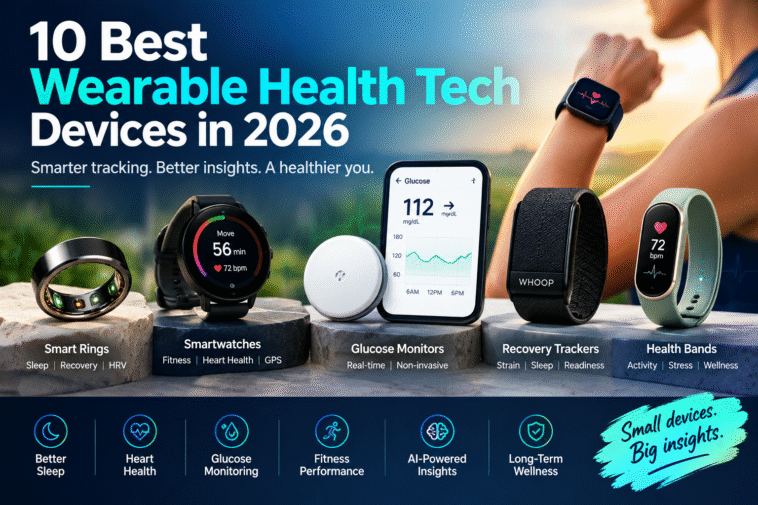
The best wearable health tech of 2026 is smaller, smarter, and more clinically credible than the fitness bands of a few years ago. Smart rings, AI-driven smartwatches, and non-invasive glucose sensors are now backed by peer-reviewed validation studies and FDA clearances, not just marketing claims. Below are the 10 devices and categories worth watching this year, what recent research actually says about their accuracy, and how to pick the right one for your goals.
How big is the wearable health tech market in 2026?
Health tracking wearables have moved from a niche gadget category into a genuine part of preventive healthcare. Market researchers at MarketsandMarkets estimate the global wearable technology market at roughly 105 billion US dollars in 2026, on track to reach nearly 239 billion by 2032, a compound annual growth rate of about 14.7 percent. The medical-grade side of the category is growing even faster. Fortune Business Insights projects the wearable medical devices market to climb from about 117 billion dollars in 2026 to over 505 billion by 2034, a 20 percent CAGR, as health systems lean harder on continuous, at-home monitoring.
Smart health wearables in 2026 are not just multiplying in number, they are getting more capable. Industry analysis from Business Research Insights found that 63 percent of wearables launched recently include AI-driven health analytics, 41 percent include ECG monitoring, and smartwatch penetration among US adults has reached 46 percent. Continuous glucose monitors have quietly become one of the fastest-growing segments too, with the CGM market projected to roughly double between 2026 and 2031 as the technology expands beyond diabetes care into general wellness.
The 10 best wearable health tech devices of 2026
Each pick below is a self-contained answer to “should I get this one,” organized from smart rings through smartwatches, glucose devices, and specialty sensors, so you can jump to the category you actually need.
1. Oura Ring 4: best overall smart ring for health tracking
Oura still leads the smart ring category, reportedly holding more than three-quarters of the market and crossing 5.5 million cumulative rings sold. In an independent single-night study against polysomnography, the Oura Ring showed the closest overall match to lab-measured sleep stages among healthy adults, and it was not statistically different from the gold standard for wake, light, deep, or REM sleep estimation. It is the best smart ring for health tracking if you want the broadest metric set and the most mature sleep coaching software.
2. Ultrahuman Ring AIR: best for metabolic and glucose tracking
Ultrahuman’s Ring AIR pairs sleep, recovery, and HRV tracking with integration to an external continuous glucose monitor, without requiring a mandatory subscription. The company reported 64 million dollars in 2025 revenue, a 5.4x jump from the year before, and now holds an estimated 9 to 10 percent global smart ring share. It is the pick for anyone treating this as a wearable glucose monitor for 2026, not just a sleep tracker.
3. Samsung Galaxy Ring: best for Galaxy ecosystem users
Samsung’s Galaxy Ring benefits from deep integration with the wider Galaxy device lineup, and Samsung’s 2025 agreement to acquire digital-health platform Xealth gives it a longer-term path into connected-care systems used by more than 500 hospitals. It is the strongest choice if you already live inside the Samsung ecosystem and want your ring, watch, and phone health data unified in one app.
4. Circular Ring 2: best for on-finger heart rhythm screening
Circular’s Ring 2 combines a titanium build, an eight-day claimed battery life, and a single-lead ECG with an FDA-cleared atrial fibrillation detection algorithm. That FDA clearance is the key differentiator: most rings estimate heart metrics from optical sensors alone, while Circular adds an actual electrical reading, which is the more clinically trusted way to flag irregular heart rhythm.
5. Apple Watch (Series lineup): best all-in-one smartwatch
Apple continues to lead the broader wearable technology market through ecosystem integration, ECG, blood oxygen, and fall detection in a single device. Around 61 percent of American consumers say they prefer wearables with built-in AI fitness coaching, and Apple’s software layer is a major reason the Apple Watch remains the default choice for people who want one device that does almost everything.
6. Garmin and Huawei smartwatches: best for validated sleep and fitness metrics
A validation study of the Huawei Watch GT2 against polysomnography in 98 sleep clinic patients found 95.9 percent sensitivity for basic sleep versus wake detection, with acceptable agreement on total sleep time and sleep efficiency, though accuracy dropped in patients with sleep apnea or insomnia. Garmin devices show similar strengths in independent testing: strong sleep and wake detection, with the usual research caveat that finer sleep-stage breakdowns are less reliable across every brand, not just these two.
7. WHOOP: best for recovery-focused athletes
WHOOP’s screenless, subscription-based model is built around recovery and strain scoring rather than a traditional watch face. Independent research comparing wearables against gold-standard references found WHOOP led specifically on deep sleep detection accuracy among the devices tested, making it a strong option for people who care more about training load and recovery than notifications or apps.
8. Dexcom Stelo and FreeStyle Libre 3 Plus: the only wearable glucose monitors cleared for real use
If glucose is the priority, these are the devices to know. Both hold FDA 510(k) clearance and use a small sensor inserted just under the skin, not a purely optical wrist or ring reading. This matters because, as of 2026, the FDA has explicitly stated that no smartwatch or smart ring is cleared, approved, or authorized to measure blood glucose non-invasively. Anything marketed as a no-needle wearable glucose monitor for 2026 should be treated as a wellness trend indicator, not a medical device.
9. Empatica health monitoring platform: best for clinical symptom tracking
In August 2026, Empatica received FDA 510(k) clearance for its wearable platform to continuously monitor Parkinson’s disease symptoms. It is a niche pick for most readers, but it signals where the category is headed: regulators are increasingly comfortable clearing wearables for specific clinical use cases, not just treating them as consumer fitness gadgets.
10. Next-generation non-invasive glucose sensors: the one to watch, not buy yet
A study published in Scientific Reports in May 2026 described a new wearable biosensor that reads glucose directly from sweat using a field-effect transistor array built from silver nanowire and MXene materials. Multiple other research groups are testing photoplethysmography combined with machine learning to estimate blood glucose from wrist-based light sensors. None of this has reached full regulatory approval, but it is the technology most likely to finally deliver an accurate, needle-free wearable glucose monitor in the next few years.
Wearable health tech comparison table
| Category | Best for | 2026 market signal | Research-backed strength |
| Smart rings (Oura, Ultrahuman, Galaxy Ring) | Overnight metrics, discreet wear | ~49% shipment growth in a year (IDC) | Oura shows the closest sleep-stage match to polysomnography among healthy adults in independent studies |
| Smartwatches (Apple, Garmin, Samsung) | All-day tracking, ECG, notifications | 46% of US adults now wear one | Sleep/wake detection sensitivity above 95% across major models |
| Continuous glucose monitors | Diabetes management, metabolic insight | CGM market projected to nearly double by 2031 | FDA-cleared skin-sensor CGMs; wrist-based optical estimates remain unapproved |
| Wearable ECG / AFib detection | Heart rhythm screening | 41% of new wearables now include ECG | FDA-cleared algorithms available on select rings and watches |
How do I choose the right wearable health device?
Match the device to the specific thing you want to know, rather than buying the one with the longest feature list.
• Want the least intrusive daily tracker: a smart ring gives you overnight heart rate variability, temperature, and sleep data without a screen or notifications competing for your attention.
• Want one device for everything: a smartwatch still covers the widest range, from workouts and notifications to ECG and blood oxygen, in a single wearable.
• Managing diabetes or prediabetes: use an FDA-cleared continuous glucose monitor, not a smartwatch or ring marketed for glucose “trends,” since none of those are currently authorized for medical decisions.
• Chasing better sleep: treat any wearable’s sleep score as a trend indicator over weeks, not a precise nightly reading, and talk to a doctor if you suspect sleep apnea or insomnia rather than relying on the device alone.
FAQs
There is no single best device, since the category has split by use case. Smart rings like Oura and Ultrahuman lead for overnight recovery metrics, smartwatches from Apple, Garmin, and Samsung remain the most versatile all-day option, and FDA-cleared continuous glucose monitors are still the only reliable choice for actual glucose management.
For overnight metrics like heart rate variability and sleep staging, independent studies have found smart rings such as the Oura Ring perform at least as well as, and in some comparisons better than, wrist-worn devices. For daytime activity, GPS, and ECG features, smartwatches typically offer more complete data.
Not yet in any medically approved way. As of 2026, the FDA has stated clearly that no smartwatch or smart ring is cleared to measure blood glucose non-invasively. Devices marketed for glucose “trends” use optical sensors that estimate patterns with roughly 70 to 85 percent accuracy under ideal conditions, which is not precise enough for treatment decisions.
Most consumer wearables detect whether you are asleep or awake with over 95 percent sensitivity, which is close to lab-grade actigraphy. Accuracy drops noticeably when trying to distinguish light, deep, and REM sleep stages, and drops further in people with diagnosed sleep disorders, so a wearable is a helpful trend tool but not a diagnostic replacement for polysomnography.
Yes, significantly. Market researchers estimate the overall wearable technology market at over 100 billion dollars in 2026, with the medical-grade wearable segment growing even faster, projected to more than quadruple by the early 2030s as continuous, at-home health monitoring becomes standard practice.