kiruthika
Introduction
Short answer: true holograms already work in labs, cars, hospitals and AR prototypes in 2026, but a Princess Leia–style image floating in your living room is still roughly a decade away. What changed this year is the pace. Nature and Nature Photonics published a run of holography papers between May and September 2026, and analysts now value the holographic display market at about USD 5.3 billion for 2026.
This guide explains holographic displays in plain language: what counts as a real hologram, how the technology works, what 2026 research proved, which companies are shipping products, whether holographic phones exist, and an honest timeline for when holograms become everyday tech.
What is a real hologram? (And what isn’t)
A real hologram recreates the light waves an object would reflect, including their phase, so your eyes focus at true depth without glasses. Most “holograms” at concerts and in shopping malls are clever illusions that only look 3D.
| Technology | How it works | True hologram? | Where you see it |
| Pepper’s ghost | A 2D video reflected off angled glass or foil | No — a flat reflection | Concert “hologram” performers, museum shows |
| Spinning LED fans | LED blades spin fast enough to persist in vision | No — 2D image in mid-air | Retail and event advertising |
| Light-field displays | Lens arrays send different images to different viewing angles | Partly — real parallax, limited focus | Looking Glass, Leia, glasses-free 3D monitors |
| Volumetric displays | Light is emitted at points inside a 3D volume | 3D, but not wave-based | Research labs, specialist visualization |
| Computer-generated holography (CGH) | A spatial light modulator shapes laser light into a reconstructed wavefront | Yes — full depth and focus cues | AR glasses prototypes, holographic HUDs, medical imaging |
The key test is focus. With a true hologram, your eyes refocus naturally between near and far objects, which avoids the eye strain behind many VR headaches.
How holographic displays work, in four steps
A holographic display computes an interference pattern, writes it to a light-shaping chip, and shines coherent light through it so the original 3D wavefront rebuilds itself in space.
1. Model the 3D scene. Software describes objects as point clouds, layers or meshes, including depth and lighting.
2. Compute the hologram. A computer-generated hologram (CGH) algorithm calculates how light from every point would interfere. In 2026, most leading labs use neural networks to do this in real time.
3. Display the pattern on a spatial light modulator (SLM). The SLM is a chip with millions of tiny pixels that delay light by precise amounts (phase modulation).
4. Illuminate with coherent light. Red, green and blue lasers or LEDs pass through the SLM. The light diffracts and recombines into a 3D image your eyes can focus on.
The hard part is physics. A hologram’s viewing angle depends on how small the SLM pixels are, and the product of image size and viewing angle (called étendue) is fixed by the pixel count. Today’s chips have pixels around 3–8 micrometres, so you get either a big image with a narrow viewing zone, or a wide viewing zone with a tiny image. That trade-off explains why the first true holograms are appearing in near-eye glasses, where the image only needs to reach one pupil.
2026 research papers report: what science proved this year
The big 2026 result is that AI-computed holograms now show continuous, photorealistic depth on working prototypes, while glasses-free 3D screens reached a 150° viewing angle. Peer-reviewed highlights, newest first:
| Published | Paper (journal) | Key finding | Why it matters |
| 23 Sep 2026 | Volumetrically continuous 3D dynamic holography via cascaded light-field propagation (Nature Photonics) | Turns inter-layer crosstalk into constructive signal; an untrained neural framework gives continuous depth with better contrast and resolution | Removes the “stacked flat layers” look of earlier holograms without heavy computing |
| 24 Jun 2026 | Mesh-represented and learning-empowered hologram synthesis (Nature Communications 17, 7943) | Renders game-style mesh scenes into complex wave fields; adds a “Flying Planes” calibration dataset | Lets standard 3D content pipelines feed holographic near-eye displays |
| 17 Jun 2026 | Super-Snell scanning light-field display (SSS-LiD) (Nature Photonics 20, 905–913) | Glasses-free 3D at a 150° viewing angle; nearly 3× the angle and up to 2.5× the resolution of leading commercial displays | Pushes no-glasses 3D screens toward room-scale viewing |
| 7 May 2026 | Recent Advances and Applications of Holographic 3D Display (Research, Huang et al.) | Review of holographic 3D display progress and applications | A good primer on the full technical landscape |
| 6 May 2026 | Photorealistic 3D Holographic Display with Natural Defocus Effect (Nature Communications 17, 6117) | Physics-informed network produces correct depth ordering and natural background blur | Makes holograms look like real photos instead of laser-speckled demos |
Context from 2025: Stanford and Meta Reality Labs published a glasses-sized holographic mixed-reality prototype in Nature Photonics. Its synthetic-aperture waveguide delivered a 3D eyebox about two orders of magnitude larger than earlier holographic near-eye systems. Lead researcher Gordon Wetzstein called it a major step but said a commercial product is still years away.
The pattern: almost every 2026 breakthrough is software. Neural networks are solving image-quality problems that hardware alone could not, which is why progress feels sudden.
Holographic display market statistics 2026
The holographic display market is worth about USD 5.3 billion in 2026 and is forecast to grow roughly 25% a year, though estimates vary widely by research firm.
| Research firm | Base-year size | Forecast | CAGR |
| Global Market Insights | USD 5.3B (2026) | USD 40.8B by 2035 | 25.5% |
| Coherent Market Insights | USD 16.83B (2026) | USD 66.16B by 2033 | 21.6% |
| Mordor Intelligence | USD 5.14B (2026) | USD 11.66B by 2031 | 17.82% |
| SkyQuest | USD 5.35B (2025) | USD 20.92B by 2033 | 18.6% |
| IMARC Group | USD 3.2B (2025) | USD 16.7B by 2034 | 19.61% |
The spread comes from definitions: some firms count Pepper’s-ghost signage and 3D monitors, others only electro-holographic systems.
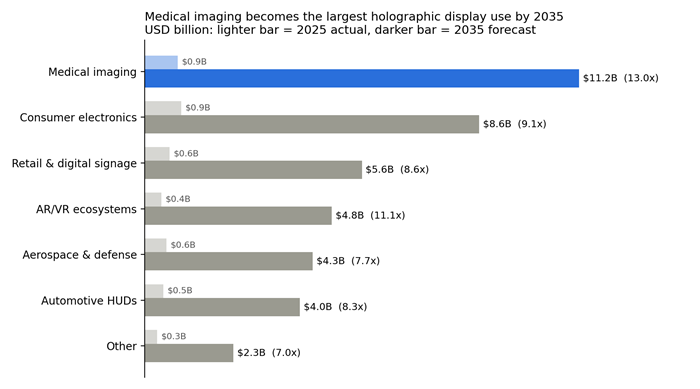
Holographic display market by application, 2025 vs 2035 (Source: Global Market Insights, Sep 2026)
Medical imaging grows about 13x, overtaking consumer electronics, because FDA-cleared systems like RealView’s HOLOSCOPE-i already sell into hospitals.
More 2025–2026 data points:
• Hardware dominates: 74.85% of 2025 revenue came from hardware such as light modulators, lasers and optics (Mordor Intelligence).
• Regions: North America is the largest market (USD 1.55B in 2025); Asia Pacific grows fastest at about 27.3% a year, with India rising from USD 115M to a forecast USD 1.47B by 2035 (GMI).
• XR devices: IDC forecast 14.3 million XR device shipments in 2025, up 39.2%, and 43.1 million by 2029 (cited by GMI).
• Advertising: Hologram Media Network launched holographic ads in 30 Simon malls in February 2025, planning 150 units.
Holographic display companies to watch in 2026
The top five vendors — Qualcomm, ViewSonic, Looking Glass, RealFiction and MDH Hologram — held 48.4% of the market in 2025, with Qualcomm leading at 16.7% (GMI). The most interesting companies, though, are the specialists building true holography:
| Company | HQ | Technology | 2026 status |
| Swave Photonics | Leuven, Belgium & Silicon Valley | HXR holographic chip with sub-300 nm pixels for AR glasses | CES 2026 Innovation Award honoree; showed a live dynamic holographic modulator and began shipping dev kits; Samsung Ventures among investors |
| Looking Glass | Brooklyn, USA | Light-field and Hololuminescent Display (HLD) | HLD uses standard video workflows; 16-inch from USD 2,000, 86-inch at USD 20,000 with spring 2026 delivery |
| Light Field Lab | San Jose, USA | SolidLight modular holographic walls, about 10 billion pixels per m² | Productizing for enterprise and entertainment; backed by about USD 85M incl. Gates Frontier, Corning, LG and Samsung |
| VividQ | London, UK | Real-time CGH software and engines for AR/VR and automotive | About USD 29.6M raised; 14 patents filed |
| RealView Imaging | Israel | HOLOSCOPE-i in-air medical holograms from CT, MRI and ultrasound | FDA-cleared and CE-marked |
| Proto | USA | Life-size “hologram” display boxes | Its Luma units power Hologram Media Network’s mall ad network across 30 Simon malls |
| Meta Reality Labs + Stanford | USA | Waveguide holography for glasses | Research prototypes only; no product announced |
Holographic phone displays in 2026: rumor vs reality
No true holographic smartphone is on sale in October 2026, and the most credible leak points to around 2030. What exists today is glasses-free 3D, not holography.
• Samsung “MH1” (rumored). In May 2026, leaker Schrödinger (@phonefuturist) claimed Samsung Display is developing a holographic panel codenamed MH1 or H1. It reportedly combines a nanostructured holographic layer, eye tracking and beam steering, so tilting the phone reveals objects from new angles (Phandroid). The leaker says the project is in phase-one R&D, with mass-market holographic phones not expected before 2030. Samsung has not confirmed it.
• Real research behind it. Samsung’s Advanced Institute of Technology has published slim-panel holography work since 2020, and Samsung Research with POSTECH reported a switchable 2D/3D display in April 2026.
• What you can buy. Phones like the ZTE Voyage 3D (launched 2024 in China at CNY 1,499, about USD 206) use eye-tracked stereoscopic 3D with a 60° viewing angle. That works like a Nintendo 3DS, not a hologram.
Bottom line: if a 2026 ad promises a “hologram phone,” it almost certainly means lenticular or eye-tracked 3D.
The five obstacles still blocking real holograms
Physics, computing power and cost — not imagination — set the pace:
• Pixel size and étendue. A wide, large hologram needs pixels near the wavelength of light (about 0.5 micrometres). Most spatial light modulators are 3–8 micrometres, which is why Swave’s sub-300 nm pixel chip draws so much attention.
• Data and computing. A room-scale hologram would need billions of pixels refreshed 60+ times a second. Light Field Lab’s panels target about 10 billion pixels per square metre.
• Speckle and image quality. Laser light creates grainy speckle. The 2026 Nature Communications papers show neural networks cutting this and adding natural blur.
• Cost of precision optics. Stanford’s 2024 AR system needed e-beam-lithography metasurfaces and fibre-coupled lasers, and SIGGRAPH Asia 2025 automotive research names cost and manufacturing complexity as barriers.
• Content and standards. Few tools produce holographic content, and most vendors use proprietary pipelines. GMI estimates limited software compatibility trims about 1.8 points off the market’s growth rate.
When will holograms be real? A realistic timeline
Expect true holograms first in AR glasses later this decade, in phones around 2030, and as walk-around room-scale displays only after 2035.
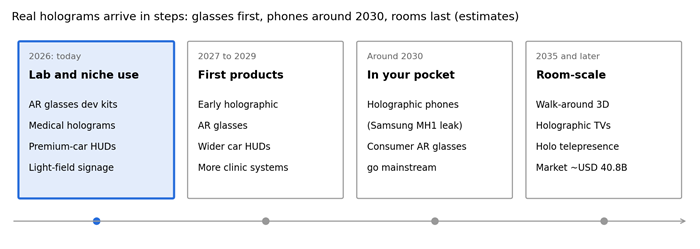
Estimated hologram adoption timeline, 2026 to 2035+
Near-eye glasses come first because the hologram only needs to reach one pupil, which today’s pixel sizes can handle. Phones depend on panels like Samsung’s rumored MH1. Room-scale holograms need billions of pixels and far smaller pixel pitch, so they arrive last. All dates beyond 2026 are estimates, not company commitments.
Conclusion
Real holograms are no longer science fiction; in 2026 they exist in labs, clinics and early dev kits, but not yet in your pocket or living room. The fastest progress comes from AI-computed holography, the money follows into AR glasses, medical imaging and automotive HUDs, and the honest consumer timeline starts around 2028–2030.
Watch three signals: Swave and similar chips reaching production AR glasses, Samsung confirming its holographic panel, and the next Stanford/Meta paper moving waveguide holography toward a product.
Sources
• Nature Photonics, Displays research listing (Sep 2026)
• Nature Communications, Mesh-represented and learning-empowered hologram synthesis (Jun 2026)
• Nature Photonics, Super-Snell scanning light-field display (Jun 2026)
• Nature Communications, Photorealistic 3D Holographic Display with Natural Defocus Effect (May 2026)
• Research, Recent Advances and Applications of Holographic 3D Display (May 2026)
• Global Market Insights, Holographic Display Market Report (Sep 2026)
• Mordor Intelligence, Holographic Display Market 2026–2031
• IMARC Group, Holographic Display Market
• Coherent Market Insights, Holographic Display Market 2026–2033
• Road to VR, Meta & Stanford holographic XR display
• Business Wire, Swave CES 2026 Innovation Award; Jon Peddie Research, Swave at CES 2026
• Light Field Lab profile; CB Insights, VividQ
• Phandroid, Samsung MH1 leak; GSMArena, ZTE Voyage 3D
FAQs
Yes, at small scale. Lab prototypes and some medical and automotive systems create true wavefront holograms. Large, free-floating holograms you can walk around remain out of reach.
No. Those shows used Pepper’s ghost reflections or LED screens. They look 3D from the audience but are flat images.
Holographic AR glasses are the likely first consumer product, in the late 2020s to early 2030s. Holographic phones are rumored around 2030, and room-scale holographic TVs are further off.
No. Samsung’s rumored MH1 panel is in early R&D. Today’s “3D phones” use eye-tracked stereoscopic screens.
Leaders include Qualcomm, ViewSonic, Looking Glass, RealFiction and MDH Hologram by market share, plus true-holography specialists Swave Photonics, Light Field Lab, VividQ and RealView Imaging.
About USD 5.3 billion in 2026, forecast to reach USD 40.8 billion by 2035 at 25.5% CAGR (Global Market Insights). Other firms estimate USD 5.1–16.8 billion for 2026, so treat any single figure as an estimate.