kiruthika
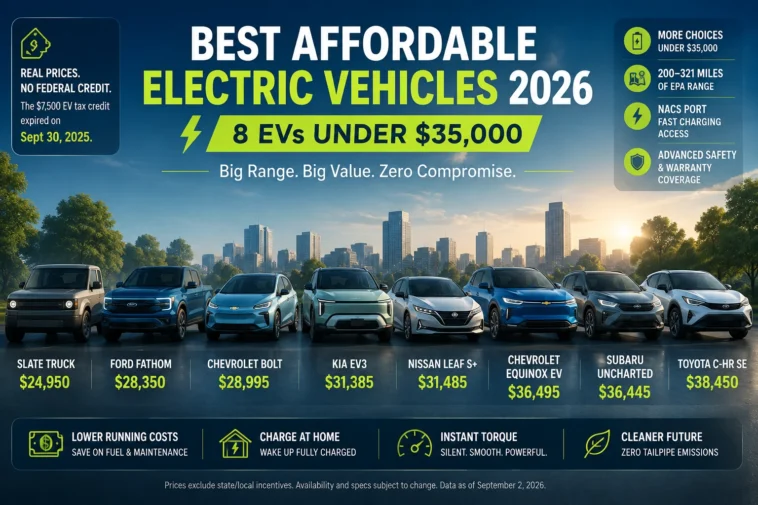
The best affordable electric vehicles 2026 buyers can actually get are led by the Slate Truck at $24,950, the Chevrolet Bolt at $28,995 and the Nissan Leaf S+ at $31,485. Add the Kia EV3, Chevrolet Equinox EV and Subaru Uncharted and you have six new EVs at or near $35,000. The catch: the $7,500 federal clean vehicle credit expired on 30 September 2025, so these sticker prices are the real prices. That single policy change is why sub-$30,000 EVs suddenly exist, and why 2026 is the first year the cheap end of the market got serious.
What the 2026 data actually says about EV affordability
Two numbers explain the whole year. The first is 6 percent. That is the share of new US light-duty vehicle sales that were battery electric in the second quarter of 2026, down from 7 percent a year earlier, according to the US Energy Information Administration using Omdia data. Conventional hybrids hit a record 16 percent over the same period.
The second number is $56,126. That was the average transaction price for a new EV in July 2026, per Kelley Blue Book, against $49,855 for the average new vehicle of any kind. The gap between EV and combustion pricing narrowed to roughly $5,800 in March 2026, the smallest in the Kelley Blue Book data set, but it has not closed.
So the market is smaller and the average EV is still expensive. What changed is the bottom of the range. Cox Automotive counted 212,600 new EV sales in Q1 2026, a 28 percent drop year over year, then 247,226 in Q2, a 14.2 percent quarterly rebound. Manufacturers responded to that shock by finally building the cars they had been promising for a decade. In 2026 alone, Slate, Ford and Kia all announced US EVs priced under $32,000.
The cost floor underneath all of this is battery pricing. BloombergNEF’s December 2025 survey put volume-weighted lithium-ion pack prices at $108 per kWh, an 8 percent annual decline, with battery-electric packs at $99 per kWh. BNEF projects roughly $105 per kWh across 2026. The IEA’s Global EV Outlook 2026, published on 20 May 2026, reports that global electric car sales passed 20 million in 2025 at about a quarter of all new cars sold, and attributes falling sales-weighted prices in the US, China and Germany largely to cheaper cells plus non-battery component savings.
Which EVs cost under $35,000 in 2026?
Here are the EVs under $35,000 in 2026, ranked by starting price. Prices are base MSRP as published by each manufacturer. Destination charges are listed separately because they vary and are not optional.
| Model | Base MSRP | With destination | EPA range | Availability |
| Slate Truck | $24,950 | Not disclosed | 205 mi (est.) | Deliveries from Q4 2026 |
| Ford Fathom | $28,350 | $29,945 | Not announced | Pre-orders early 2027 |
| Chevrolet Bolt | $27,600 | $28,995 | 262 mi | On sale now |
| Kia EV3 | $29,890 | $31,385 | 221 mi base, 321 mi max | On sale late 2026 |
| Nissan Leaf S+ | $29,990 | $31,485 | 303 mi | On sale now |
| Chevrolet Equinox EV LT FWD | $34,995 | $36,495 | 319 mi | On sale now |
| Subaru Uncharted Premium FWD | $34,995 | $36,445 | 300+ mi (mfr. est.) | On sale now |
| Toyota C-HR SE | $37,000 | About $38,450 | 287 mi | On sale now |
Prices current as of 2 September 2026. The Chevrolet Bolt is sold as a 2027 model year vehicle. The Kia EV3 is a 2027 model going on sale in calendar 2026.
The 8 best cheap EVs of 2026, ranked by price
1. Slate Truck, $24,950
The cheapest new EV in America, and the most unusual. Slate Auto, backed by Jeff Bezos and holding more than $1.3 billion in funding, opened pre-orders on 24 June 2026 for a two-seat electric pickup with a 65 kWh LFP pack and an estimated 205 miles of range. There is no paint, no infotainment screen and no power windows. The body is unpainted gray composite that you wrap yourself, and Slate sells over 200 accessories plus a kit that converts the truck into a five-seat SUV. It is rated for 1,500 pounds of payload and 2,000 pounds of towing, and comes with a 10-year, 110,000-mile battery and powertrain warranty. First deliveries are expected in Q4 2026 from the company’s Warsaw, Indiana plant, with more than 180,000 reservations already logged.
Buy it if you want maximum utility per dollar and genuinely do not care about features. Skip it if you cannot absorb the risk of a first-time automaker’s first production run.
2. Ford Fathom, $28,350
Announced on 6 August 2026, the Fathom is a five-seat midsize electric pickup and the first vehicle on Ford’s Universal EV Platform. Ford says the platform cuts total part count by 20 percent and eliminates 40 percent of assembly workstations, which is how a company gets an electric truck to $29,945 including the $1,595 destination fee. Every Fathom will be BlueCruise-capable with bidirectional power and a NACS port, and Ford claims more passenger volume than a Toyota RAV4 before you count the bed and frunk. CEO Jim Farley has called the platform Ford’s Model T moment.
The important caveat: pre-orders open in early 2027 and deliveries follow later that year. Range, horsepower and the exterior design have not been released. This is a 2026 announcement, not a 2026 purchase.
3. Chevrolet Bolt, $28,995
The Bolt returned in January 2026 after a two-year hiatus and is currently the cheapest EV you can walk into a dealership and buy. The 65 kWh LFP pack delivers an EPA-rated 262 miles, above GM’s own initial 255-mile estimate. It makes 210 horsepower, charges at 150 kW or better on a native NACS port, and includes a heat pump as standard. The base LT is $27,600 before the $1,395 destination charge; the sportier RS runs $32,995 delivered.
One thing to watch: GM has described the new Bolt as a limited-run model, so availability may tighten.
4. Kia EV3, $29,890
Kia was expected to price the EV3 near $35,000. It came in at $29,890, or $31,385 with the $1,495 destination fee, which undercuts the Nissan Leaf by exactly $100. The base Light trim uses a 58.3 kWh pack good for 221 miles and 201 horsepower. Step up to Wind or Land front-wheel drive and you get an 81.4 kWh pack rated at up to 321 miles, the longest range of any EV in this price bracket. All-wheel drive is available, which neither the Bolt nor the Leaf offers, and vehicle-to-load is standard. The 288-horsepower GT tops the range at $45,890.
US sales begin in late 2026 as a 2027 model. If you can wait, the Wind FWD is arguably the strongest value in the entire segment.
5. Nissan Leaf S+, $29,990
The third-generation Leaf abandoned the hatchback shape for subcompact SUV proportions and gained a genuinely competitive powertrain. The 75 kWh battery returns 303 miles in S+ trim, the highest range of any EV currently on sale under $32,000. It charges at up to 150 kW and ships with two ports, a NACS inlet for Tesla Superchargers and a J1772 for AC charging, which is unusual and useful. ProPILOT Assist is standard. The SV+ is $35,725 delivered and the Platinum+ is $40,485.
Nissan has still not launched the promised entry-level S trim, which was expected to come in below $30,000 with a smaller battery.
6. Chevrolet Equinox EV LT FWD, $34,995
The range champion of the affordable segment at 319 EPA miles, and one of the three best-selling EVs in the US. You get 220 horsepower, a 17.7-inch infotainment screen, 102 cubic feet of interior space and a native NACS port for $36,495 delivered. GM has been running $5,000 customer cash and 0 percent APR offers on remaining 2026 stock ahead of the 2027 model, so the real transaction price has been meaningfully lower than sticker.
7. Subaru Uncharted Premium FWD, $34,995
Subaru’s cheapest EV, and the first front-wheel-drive SUV the brand has sold in the US. It shares almost everything with the Toyota C-HR. The Premium FWD makes 221 horsepower with a manufacturer-estimated 300-plus miles from its 74.7 kWh pack, charges 10 to 80 percent in about 28 minutes at 150 kW, and uses a NACS port. All-wheel-drive Sport and GT trims climb to 338 horsepower at $41,245 and $45,245 delivered.
8. Toyota C-HR SE, $37,000
Just over the $35,000 line, but worth knowing about. The C-HR BEV arrived at US dealers in March 2026 with standard dual-motor all-wheel drive, 338 combined horsepower and a 4.9-second 0 to 60 time. Range is 287 miles on the SE with 18-inch wheels, 273 on the XSE with 20s. It is the performance option in a segment that otherwise optimizes for cost, and it still undercuts a base Tesla Model Y.
Does the $7,500 federal tax credit still exist?
No. The New Clean Vehicle Credit and the Qualified Commercial Clean Vehicle Credit both expired on 30 September 2025 under the One Big Beautiful Bill Act. Nothing has replaced them at the federal level.
The effect was immediate and measurable. Battery electric vehicles hit a record 12 percent of monthly US light-duty sales in September 2025 as buyers rushed the deadline, then fell off a cliff. A record 437,487 EVs sold in Q3 2025; the following quarter came in at 234,171. Slate had originally advertised its truck at under $20,000 on the assumption of the credit, and dropped that claim entirely once it went away.
Be careful with older articles and dealer pages. A surprising number of sites still list the $7,500 credit as available when quoting 2026 prices. It is not. State, local and utility incentives do still exist and vary widely, so check your own state’s program before you assume the sticker is the final number. Manufacturer incentives are also unusually generous right now: EV incentive spending averaged 14.6 percent of transaction price in March 2026, close to $8,000 per vehicle and more than double the industry average.
How do I choose the right budget electric car?
Work through these in order.
• Start with your actual daily mileage, not your worst-case road trip. The average American drives about 37 miles a day. A 205-mile Slate covers that with a week to spare if you charge at home.
• Confirm you can charge at home. This is the single biggest variable in whether an EV saves you money. Without a home outlet, the running-cost argument weakens considerably.
• Check the charge port. Every model on this list except the Leaf’s secondary port uses NACS, meaning direct Tesla Supercharger access. That was not true two years ago.
• Compare delivered price, not MSRP. Destination fees on this list run from $1,395 to $1,595 and are mandatory.
• Ask about current incentives before you negotiate. With federal support gone, manufacturer cash and financing offers are doing the heavy lifting, and they change monthly.
Is a used EV a better deal than a new one?
For many buyers in 2026, yes. Used EV sales rose 12 percent year over year in Q1 2026 to 93,500 units while new EV sales fell 28 percent, and Cox Automotive found used EV prices sitting within roughly $1,300 of equivalent gasoline cars. A three-year-old Equinox EV with 300-plus miles of range and 17,000 miles on it trades hands in the mid-$20,000s.
The trade-offs are the usual ones: shorter remaining battery warranty, older charging hardware (many pre-2025 EVs need a NACS adapter), and no manufacturer incentive to negotiate against. If you want the newest software and the full warranty, buy new. If you want the lowest cost per mile, the used market is where the value moved.
FAQs
The Slate Truck at $24,950 is the cheapest new EV announced for 2026, with deliveries starting in Q4. Among EVs you can buy at a dealership today, the Chevrolet Bolt is cheapest at $28,995 including destination, followed by the Nissan Leaf S+ at $31,485.
The Chevrolet Equinox EV LT FWD leads the under-$35,000 group at 319 EPA miles. The Kia EV3 goes further at up to 321 miles, but only in its higher Wind and Land front-wheel-drive trims, not the $29,890 base model. The Nissan Leaf S+ delivers 303 miles for under $30,000 MSRP.
At the entry level, yes. At the average, not really. The average new EV transaction price was $56,126 in July 2026, up 1.6 percent year over year after six straight months of annual declines. What has changed is the number of options below $32,000, which went from roughly one to at least five over the course of 2026. Falling battery costs are the underlying driver, with BloombergNEF projecting pack prices near $105 per kWh for 2026.
It depends on your electricity rate and whether you charge at home. The purchase-price argument got weaker when the credit expired, but the running-cost argument did not change. Fuel and maintenance savings over a vehicle’s lifetime are typically estimated in the $6,000 to $10,000 range. If you drive a lot and charge overnight at home, the math still works. If you drive rarely and rely on public DC fast charging, it may not.
The federal tax credit expiration is the main cause. US battery electric vehicle sales made up 6 percent of new light-duty vehicles in the first half of 2026, down from 7 percent a year earlier, while conventional hybrids climbed to a record 16 percent. Sales are stabilizing: Q2 2026 volume rose 14.2 percent from Q1, and the electrified share of the market as a whole grew from 22 to 24 percent year over year.