admin
admin
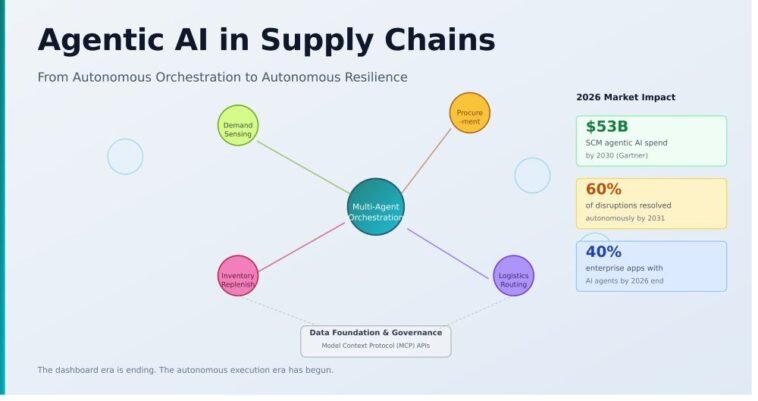
The supply chain of 2026 is no longer a linear sequence of events managed by humans interpreting dashboards and alerts. Agentic AI in supply chain environments is evolving into the dominant operational model, where specialized agents continuously sense disruptions, propose solutions, and execute corrective actions in minutes—often before a human ever sees an anomaly.
This shift marks the end of an era defined by visibility and the beginning of one defined by autonomous resilience. Multi-agent systems logistics orchestration is now the architectural standard for organizations deploying autonomous supply chain orchestration at scale. And the data shows it’s accelerating: Supply chain management (SCM) software with agentic AI capabilities will grow from less than $2 billion in 2025 to $53 billion in spend by 2030, and Gartner predicts 60% of supply chain disruptions will be resolved without human intervention by 2031.
The operational implications are profound. Organizations no longer wait for a planner to open a dashboard at 9 a.m. The agentic system has already acted, recalibrated, and logged the decision with full lineage. This is not incremental optimization. This is structural transformation.
The Evolutionary Shift: Difference Between Predictive AI and Agentic AI in Logistics
Understanding what agentic AI actually changes requires stepping back to see how supply chain intelligence has evolved. Three distinct eras have emerged, each solving a different problem—and each creating blind spots that the next generation had to address.
| Dimension | Traditional AI (Predictive) | Generative AI (Conversational) | Agentic AI (Autonomous) |
|---|---|---|---|
| Primary Output | Statistical forecast or alert | Natural language explanation or recommendation | Autonomous decision + execution + documented rationale |
| System Architecture | Isolated analytics engine | Conversational interface layered on data APIs | Networked micro-agents with native API integrations |
| Human Role | Interpret data, make decision, manually execute | Ask questions, receive recommendations, still execute manually | Set policy guardrails; agents execute within bounds; humans handle exceptions |
| Response Time | Hours or days (dashboard lag + human decision lag) | Minutes (if human is available and engaged) | Seconds to minutes (fully autonomous) |
| Example Scenario | Forecast predicts demand spike; analyst reads report; planner reorders stock | User asks chatbot “should we increase inventory?”; chatbot explains; person manually approves and places order | Demand sensor detects signal; replenishment agent assesses inventory; procurement agent confirms supplier capacity; order placed automatically within preset thresholds |
| Failure Mode | Late decision. Stockout or overstock. | Good explanation but human delays action. | Data quality issues cause wrong decisions without human intervention. |
Traditional AI was built to answer the question: “What will happen?” Generative AI asked: “How do I explain what’s happening?” Agentic AI answers: “What do we do about it—and do it now?”
The distinction is not semantic. The agentic AI segment tied specifically to logistics and supply chain is estimated at $8.67 billion in 2025, projected to reach $16.84 billion by 2030 at roughly 14.2% CAGR. That’s not general AI spending. That’s money going specifically into autonomous decision agents embedded in logistics workflows.
The convergence is visible in adoption data. Forty percent of enterprise applications will be integrated with task-specific AI agents by the end of 2026, up from less than 5% today. In supply chain specifically, AI agents will identify risks and opportunities, propose workarounds, onboard suppliers, and even trigger corrective actions automatically within trusted guardrails.
But here’s the critical nuance: This does not replace planners and logistics experts; it augments them. The emerging pattern is “human plus machine,” where copilots embedded in planning workspaces and logistics processes handle repetitive analysis while people focus on scenario choice, exception management, and stakeholder communication.
Multi-Agent Architectures for Enterprise Warehousing & Logistics: How Specialized Agents Coordinate
The most consequential architectural shift in 2026 is the move away from single, monolithic AI systems toward multi-agent ecosystems—specialized micro-agents that collaborate through standardized APIs to solve complex, cross-functional problems.
This matters because supply chain decisions are inherently cross-functional. A sudden 40% demand surge in Northern Europe doesn’t just affect inventory. It affects procurement, logistics routing, supplier communication, customs compliance, working capital, and risk assessment. A single LLM trying to reason through all of that in parallel becomes slow and unreliable. Specialized agents, each optimized for its domain, working in native coordination, solve it faster and with lower latency.
How Do Autonomous AI Agents Handle Port Delays: Real-Time Example
Consider this concrete example: A regional port experiences a 48-hour congestion event due to a labor dispute. Container dwell times triple. This cascades into the supply chain of a consumer electronics retailer. Without agentic orchestration, this requires manual escalation, phone calls, email chains, and delayed decisions. With it, the system moves autonomously.
Hour 0 — Disruption Detected: The Logistics Visibility Agent continuously ingests real-time port data, vessel schedules, and container tracking feeds. It detects that containers destined for the retailer’s central distribution hub are experiencing 72-hour delays instead of the expected 24 hours. It immediately notifies downstream agents and flags the disruption event.
Hour 0:15 — Demand Sensor Activates: The Demand Sensing Agent has been tracking several signals: social media sentiment around a new product launch, weather forecasts for key markets, competitor promotional activity, and historical demand patterns by SKU and region. When the port disruption is flagged, it recalculates fulfillment scenarios. If the port delay extends, certain high-velocity SKUs will face stockouts in key markets within 4 days. It escalates priority signals to the next layer.
Hour 0:45 — Inventory Replenishment Agent Proposes Options: The Inventory Replenishment Agent receives the demand sensing alert and current inventory state. It has four options:
- Expedite airfreight from overseas supplier (high cost, fast delivery).
- Activate emergency stock from a regional warehouse (medium cost, medium lead time).
- Split shipments across multiple carriers and ports (logistically complex, acceptable lead time).
- Accept planned stockout and adjust demand forecasts down (safest but revenue impact).
The agent calculates net present value and margin impact for each scenario and recommends Option 2 + Option 3 as the hybrid approach, with specific quantities and timing.
Hour 1 — Procurement Agent Executes: The Procurement Agent takes the replenishment recommendation and checks supplier capacity, committed inventory at the regional warehouse, and carrier availability across three alternative ports. It queries supplier APIs in real-time, confirms 2,000 units are available at the regional facility and can be shipped within 36 hours via expedited ground transport. It drafts a procurement order, checks that it’s within approved spend thresholds for the category, and submits it. No human approval required for commodity purchases under $500K; instead, a log entry is created and the decision is auditable.
Hour 1:30 — Logistics Routing Agent Optimizes: The Logistics Routing Agent receives confirmation that inventory is being expedited from the regional warehouse. It has to route 2,000 units through three different transport modalities (ground from regional hub, air from supplier location, ground from alternate port). It factors in real-time traffic, weather, carrier capacity, and SLA windows for delivery to the central hub. It generates three routing options with cost-service tradeoffs and selects the one that meets the SLA and minimizes cost overage.
Hour 2 — Compliance & Risk Agent Validates: The Compliance & Customs Agent runs a background check on all activated suppliers and carriers. It confirms that all parties have current certifications, no sanctions flags, and proper documentation chains. It pre-stages customs documentation for the alternate port entry. It flags that one of the three alternative carriers has a pending compliance audit and recommends against using it for sensitive SKUs. The logistics agent re-routes accordingly.
Hour 2:15 — Summary & Escalation: All agent actions are logged, aggregated, and surfaced to the Human Exception Agent—essentially a workflow orchestrator that decides what needs human attention. In this case:
- Routine procurement and logistics decisions executed within guardrails: logged, no escalation needed.
- One carrier flagged for compliance risk but not critical to the solution: flagged for the compliance team to review during their next shift.
- Demand forecast updated based on port disruption: this is forwarded to the Chief Supply Chain Officer with a summary explaining the scenario and the autonomous actions taken.
The CSCO reads a two-page summary, not a 47-email thread. She has full visibility into why the decision was made, what the alternative scenarios were, and what the financial impact is. She has the option to override, but 94% of the time, well-designed agents operating within guardrails make better decisions faster than humans can.
Result: The supply chain mitigated a disruption that would have caused a 3–5% revenue loss in that region without any human-initiated workaround. The agents detected, planned, and executed autonomously. Cost of this autonomy: AI infrastructure, data integration, and governance. Cost of not having it: margin erosion, customer churn, and operational crisis mode.
Multi-Agent Architecture Deep Dive: How Specialized Agents Eliminate Latency & Scale
The diagram below illustrates how a multi-agent ecosystem workflow responds to a real supply chain disruption in real time:
Multi-Agent Supply Chain Ecosystem Architecture [Diagram showing: Port congestion disruption event at center, five specialized agents (Demand Sensing, Inventory Replenishment, Procurement, Logistics Routing, Compliance & Risk) responding via Model Context Protocol API layer, coordinating through inter-agent communication, funneling decisions to Human Exception Agent, resulting in autonomous resolution]
This architecture demonstrates why multi-agent systems for enterprise warehousing outperform monolithic approaches. Each agent specializes in a single domain (demand forecasting, inventory optimization, procurement negotiations, route optimization, regulatory compliance). They communicate through Model Context Protocol standard APIs instead of fragile custom integrations. When a disruption occurs, the agents activate in sequence, hand off context and decisions to the next layer, and reach a coordinated resolution in minutes—not days.
Why Multi-Agent Systems Architecture Outperforms Single-Agent Models: Technical Foundations
The reason this approach works better than a single monolithic agent lies in inference latency, domain-specific training, and coordinated handoff design.
A single large language model trying to simultaneously reason about:
- Port congestion scenarios
- Inventory position and regional distribution
- Supplier capacity and lead times
- Carrier availability across five different modalities
- Customs and regulatory constraints
- Financial guardrails and approval hierarchies
…becomes slow. Inference time stretches. The model hallucinates edge cases. Context windows get exceeded. Latency kills.
Specialized agents, by contrast:
- Are fine-tuned or trained on domain-specific data (logistics networks, supplier master data, regulatory databases).
- Operate at lower inference latency because they’re solving a narrower problem.
- Coordinate through well-defined API contracts, not natural language ambiguity.
- Can be updated independently when market conditions change (e.g., a new supplier comes online; only the Procurement Agent’s knowledge graph is refreshed).
This is why Multi-agent systems are collaborative AI ecosystems that mimic human teams. They consist of specialized agents working together to solve complex problems in areas like supply chain management, HR, and finance. These systems can adapt to changing conditions, enabling businesses to respond proactively to challenges.
The infrastructure enabling this is emerging. Model Context Protocol (MCP) servers—standardized wrappers around data sources and business logic—allow agents to discover and call each other’s capabilities without hard-coding integrations. Instead of building custom API layers between systems like SAP Oracle multi-agent integration points, teams define MCP interfaces that let agents say: “I need current inventory position. I’ll query the Inventory Agent via its standard MCP endpoint.” This eliminates brittle, point-to-point integrations and creates scalable, discoverable agent ecosystems.
Critical insight: The supply chain organizations winning in 2026 are not those with the most sophisticated single AI model. They’re the ones with the cleanest data plumbing and the clearest agent responsibility boundaries. Multi-agent systems are only as good as the data they operate on.
How Agentic AI Solves Supply Chain Friction: AI Agents for Inventory Management, Exception Resolution & Dynamic Routing
The operational benefits of agentic AI become concrete when applied to the specific friction points that plague modern supply chains.
AI-Driven Dynamic Routing Systems: Autonomous Exception Resolution in Real Time
Traditional routing software builds a plan before the truck leaves the yard. The plan is static. When things change—a highway closure, a storm, a mechanical problem, a dock delay—someone has to notice, someone has to manually reroute.
With agentic routing, this becomes continuous and autonomous. The Logistics Routing Agent ingests live feeds:
- Telematics from the fleet (location, fuel, engine diagnostics, traffic sensors).
- Real-time traffic and weather APIs.
- Dock and facility status updates.
- Customer delivery window constraints.
When a highway closure is reported, the system doesn’t wait for a dispatcher to notice. The agent recalculates the optimal route within seconds. If the new route means a delivery will miss its window, the agent checks whether the customer can accept a 30-minute delay or whether the shipment needs to be handed off to a different vehicle. It communicates the change to the driver, the customer, and the billing system without human intervention.
Operational impact: A mid-size 3PL that deployed agentic routing in Q4 2025 reported a 12% reduction in fuel spend and a 6% improvement in on-time delivery through continuous micro-routing adjustments that human dispatchers could never have executed in real-time.
Smart Warehousing & Dynamic Inventory Slotting
Modern warehouses manage millions of SKUs with constantly shifting demand. A product that was slow-moving last month might be the fastest-mover this week due to a sales promotion, seasonal demand, or viral social media trend. Traditional warehouse management systems (WMS) use static slot assignments. High-velocity SKUs are supposed to be in “pick zones,” but the definitions are updated quarterly, not hourly.
Enter the Warehouse Orchestration Agent. This agent:
- Tracks real-time order velocity for every SKU across the last 24 hours, 7 days, and 30 days.
- Monitors pick path distances and labor efficiency metrics.
- Triggers dynamic reslotting of inventory based on predicted short-term demand.
- Coordinates with material handling equipment (autonomous guided vehicles, robotic picking systems) to move high-velocity stock into more accessible zones.
Instead of a picker walking 600 feet to retrieve an item that’s been moved to a far corner of the warehouse, the fast-mover is dynamically repositioned into a high-throughput zone. The labor savings are significant. A large food and beverage distributor that deployed this in 2025 reported an 8% reduction in picking labor per unit of throughput and a 3% improvement in order accuracy because pickers spend less time navigating and more time picking.
Automated Customs Compliance Agents: Autonomous Cross-Border Regulatory Navigation
International supply chains drown in compliance friction. Customs regulations change by port, by trade agreement, by commodity classification, and by origin-destination pairs. A shipment from Vietnam to Germany for industrial electronics has different documentation, duty rules, and security requirements than the same product shipped to the UK.
The Compliance & Trade Agent automates this nightmare:
- Ingests live updates from customs authorities, trade agreement databases, and sanctions lists.
- For every shipment, automatically classifies the commodity using HS codes.
- Cross-references the origin, destination, and shipper against sanctions and restricted party lists.
- Generates required documentation (commercial invoices, packing lists, certificates of origin) in the correct format for the destination port.
- Flags edge cases or prohibited combinations that require human review.
A pharmaceutical exporter that deployed this reduced time-to-export documentation from 4 hours per shipment to 15 minutes. More importantly, it eliminated compliance errors that had previously caused port delays and regulatory audits.
Data Infrastructure Requirements for Agentic AI Deployment: Why Governance Is the Gatekeeper
Here’s where the narrative takes a sobering turn. None of this works without exceptional data governance.
Agentic AI systems are far less forgiving of poor data than traditional BI systems. A bad data point in a dashboard gets flagged as an outlier and a human analyst dismisses it. A bad data point in an autonomous agent causes it to make a wrong decision and execute it—at scale, at speed, with no human checkpoint.
The research is unambiguous on this vulnerability. For agentic AI, half of leaders still cite data quality and retrieval as their biggest challenge. Governance is playing catch-up. Three out of four organizations admit their governance hasn’t kept pace with AI adoption.
This creates a production-readiness gap. Almost four in five enterprises have adopted AI agents in some form, yet only one in nine runs them in production. This 68-percentage-point gap represents the largest deployment backlog in enterprise technology history.
The blockage is not the AI models. It’s the data foundation.
The Specific Data Challenges in Supply Chain
Supply chain data inherits a toxic combination of structural problems:
Fragmentation across Legacy Systems: Supply chain data lives across ERP systems (SAP, Oracle, Microsoft Dynamics), warehouse management systems (Manhattan, Blue Yonder), transportation management systems (JDA, Descartes), supplier portals (Ariba, Coupa), and a dozen point solutions for customs, visibility, and analytics. Each system has its own data model, update cadence, and quality standards. An agent trying to get a complete view of a shipment has to query seven systems, each responding on different cycles, with different latency and freshness guarantees.
Inconsistent External Standards: Suppliers and third-party logistics providers report data in different formats. One supplier sends delivery dates as YYYY-MM-DD; another sends month names. One reports quantity in cases; another in units. Standardizing this upstream is hard. Building data transformation pipelines that handle thousands of suppliers with inconsistent formats is harder.
Master Data Chaos: A product has a different SKU in the ERP, a different identifier at the warehouse, and a different barcode at the supplier. A customer has three different account numbers across the billing, order management, and logistics systems. A supplier is registered with two different legal entities across two different procurement systems because of a historical acquisition. Agents can’t reason reliably across systems if master data is fragmented.
Real-World Consequences
A global manufacturer deployed an agentic procurement system in Q1 2026 without fixing upstream data issues. The agent was trained to identify cost-saving opportunities by comparing supplier quotes across 18 months of historical data. But the supplier master data had duplicates—the same vendor registered under slightly different names due to mergers, address changes, and localization. The agent concluded that Supplier A and Supplier B (actually the same company) were different vendors and recommended shifting more volume to what it thought was a cheaper alternative. It was the same supplier—the “price difference” was data inconsistency. The agent executed the recommendation, and negotiations broke down when the supplier realized it was being played against itself. The system was rolled back.
The fix: Six weeks of data remediation. Master data reconciliation. Enforced naming conventions. A data stewardship program. Then the agent was retrained and re-deployed.
The Data Governance Answer
Organizations that are operationalizing agentic AI at scale are investing in three specific capabilities:
1. Data Lineage & Provenance Tracking: By 2026, 60% of large enterprises will have deployed data lineage tools to address regulatory and operational risk – up from just 20% in 2023. These tools track where data comes from, what transformations it’s undergone, and where it’s flowing. When an agent makes a decision, the lineage shows exactly which source systems and data points informed that decision. This is non-negotiable for compliance, debugging, and auditability.
2. Automated Data Quality Monitoring: Instead of periodic manual quality checks, organizations are deploying continuous, automated quality monitoring. Machine learning models trained on historical clean data flag anomalies in real-time. If supplier delivery data suddenly shows impossible lead times (48-hour lead time from a 6-month-lead-time supplier), the system catches it and quarantines it before an agent acts on it.
3. Standardized APIs & Integration Patterns: Model Context Protocol (MCP) servers are emerging as the standard for agent-to-data communication. Instead of building custom integrations, teams wrap their data sources in MCP interfaces. An agent discovers “available data sources” and queries them through a standard contract. This standardization reduces integration work and makes it easier to add new data sources or swap out systems.
The unglamorous truth: 60–70% of the work in operationalizing agentic AI in supply chains is not AI model development. It’s data infrastructure, master data management, and governance automation. The organizations that accept this and invest accordingly will win. Those expecting to overlay agents on top of messy data will fail repeatedly.
The Regulatory Push
Governance is becoming enforced, not optional. Gartner predicts that by 2026, 50% of large enterprises will have formal AI risk management programs in place, up from less than 10% in 2023. Regulations like the EU AI Act and emerging frameworks in the US, UK, and India are establishing accountability standards for autonomous systems. Organizations need to demonstrate that their agents are operating on clean data, following defined policies, and making decisions that can be audited and explained.
The Market Reality: Who’s Winning, and What They’re Doing Differently
The empirical data on agentic AI adoption in 2026 reveals clear winners and a large mass of laggards.
According to a January 2025 Gartner poll of 3,412 webinar attendees, 19% said their organization had made significant investments in agentic AI, 42% had made conservative investments, 8% had made no investments, and the remaining 31% were taking a wait-and-see approach or were unsure.
But here’s the critical nuance: having invested is not the same as having deployed. Many organizations have pilot projects. Few have production systems at scale.
The ones that do are seeing dramatic results:
Consumer Electronics & Retail: During promotional periods, agents align sudden demand surges with logistics constraints. They dynamically allocate inventory across warehouses, adjust carrier bookings, and switch to alternate suppliers when cost-effective, decreasing stock-outs by around 5% and boosting marketing-driven revenue by 6%.
Pharmaceutical & Temperature-Controlled Logistics: A large pharmaceutical company using agentic supply chain architecture for temperature-sensitive product returns reported productivity gains in the millions annually by automating compliance, quality checks, and reverse logistics workflows that previously required manual intervention.
Large Retailers Across Channels: Organizations like Walmart that unified data from thousands of stores with different systems have deployed agents to optimize inventory allocation, demand sensing, and promotional planning. The competitive advantage lies not in having a better AI model, but in having cleaner, better-integrated data that allows agents to make faster, better decisions.
The Market Forecast
By 2029, 45% of G2000 companies will have adopted agentic AI–driven channel management and orchestration, driving a 20% revenue uplift and a 30% improvement in partner and customer satisfaction scores.
Translation: If you’re not in the 45% in 2029, you’re already behind. The adoption curve is accelerating.
Agentic AI is set to dominate IT budget expansion over the next five years, exceeding 26% of global IT spending and reaching $1.3 trillion by 2029.
The Organizational Shift: Human + Machine, Not Human OR Machine
A persistent anxiety about agentic AI is that it will eliminate jobs. The research suggests something more nuanced and more interesting: the nature of work changes, but the role of humans deepens.
The supply chain of 2026 will be defined as much by the quality of its digital colleagues as by the skills of its human workforce. But humans don’t disappear. They shift from executing low-level tasks to making high-judgment calls.
Instead of a planner spending 6 hours a day analyzing data and updating forecasts, they spend 1 hour reviewing what the agents are doing and 4 hours on scenario planning, supplier negotiations, and strategic decisions that agents can’t make. This is genuinely higher-value work.
Conversational decision support: Beyond automating operational workflows, agentic AI is also changing how leadership interacts with the supply chain. Executives and non-experts can now engage directly with decision agents through natural language prompts, asking questions, testing scenarios, or validating assumptions without navigating dashboards or reports.
A CSCO can now ask: “What if we move production 30% closer to European markets? Show me the impact on lead time, inventory carrying costs, and tariff exposure.” An agent orchestrates a scenario simulation across multiple domains and returns an answer in minutes. This kind of strategic agility was previously impossible.
The 2026 Inflection Point
We are at an inflection point. Agentic AI in supply chains is no longer a proof-of-concept. In 2026, AI in the supply chain will move from proof‑of‑concept experiments to embedded, agentic capabilities that sit inside core business processes.
The competitive dynamic is clear: organizations with clean data, defined agent boundaries, and governance frameworks in place will deploy faster and extract more value. Organizations trying to overlay agents on top of fragmented data will struggle, fail pilots, and lose ground.
The investment required is not trivial. Building multi-agent ecosystems means rethinking how data flows through your organization, enforcing data standards that you may have been sloppy about for years, and creating organizational structures to steward agent behavior and outcomes.
But the cost of not doing it is now higher. By 2031, 60% of supply chain disruptions will be resolved without human intervention as AI enables increasingly autonomous supply chains. If your organization is not among those with autonomous disruption resolution by 2031, it means you’re spending human labor on problems that competitors have already automated. That’s margin erosion, customer dissatisfaction, and competitive disadvantage.
The organizations that started the data governance work in 2025 and deployed agents in 2026 will have built competitive moats by 2028. For everyone else, 2027 is the year to get serious about data foundations. Waiting until 2028 or 2029 means you’re already playing catch-up.
Conclusion: The Autonomous Supply Chain Era Is Here—Move or Lose Ground
Agentic AI in supply chains is not a distant technology or an emerging pilot program. It’s operationalizing now. Organizations are deploying multi-agent systems logistics at scale, and the gap between leaders and laggards is compounding monthly.
The evidence is conclusive:
- By 2030, 50% of cross-functional supply chain management solutions will use intelligent agents to autonomously execute decisions in the ecosystem.
- 60% of supply chain disruptions will resolve without human intervention by 2031, according to Gartner.
- Organizations with clean data and governance frameworks are extracting 5–12% margin improvements through autonomous exception resolution and dynamic routing optimization.
The path forward is not exotic—it’s unglamorous and disciplined:
- Audit your data foundation ruthlessly. Master data quality, lineage tracking, and standardized taxonomies are not optional. They are the prerequisite. Data governance is the gatekeeper—systems built on fragmented data will fail repeatedly.
- Start narrow, execute deep. Don’t attempt to build an omniscient autonomous supply chain orchestration system. Pick one high-friction workflow—AI-driven dynamic routing systems, AI agents for inventory management, or automated customs compliance agents—and deploy agents that solve it end-to-end.
- Adopt Model Context Protocol (MCP) standards immediately. Instead of building brittle custom integrations between SAP Oracle multi-agent integration points, standardize on MCP. This multiplies your leverage as you add new agents.
- Treat governance as engineering, not compliance. The winning organizations in 2026 measure agent decisions, audit outcomes, and continuously improve guardrails.
The cost of moving is real but manageable. The cost of not moving—watching competitors automate your supply chain friction while you remain reactive—is existential.
For 2026: start with your data. For 2027: deploy agents. For 2028 and beyond: you’ll either have built a competitive moat or you’ll be scrambling to catch up.
The dashboard era is ending. The autonomous execution era has begun.